 Proudly Canadian


 Home
Home Cooling
 Heating
 Heat Pumps
 Air Quality
 Other
Other
The SEER2 rating standard replaced the old SEER metric for all central AC units sold in Canada, and understanding it can make a real difference when you are buying new. If you have been shopping for a new central air conditioner in 2024 or later, you have probably seen SEER2 ratings instead of the older SEER ratings that were common for decades. SEER2 (Seasonal Energy Efficiency Ratio 2) replaced SEER as the testing standard in North America beginning in January 2023. The new standard uses a more realistic test protocol, which means a unit’s SEER2 number is typically 5 to 7 percent lower than the same unit’s old SEER number, even though the unit itself has not changed.
This matters if you are comparing quotes that mix old and new equipment specs, or if you are trying to interpret efficiency claims. Here is what SEER2 actually measures, what the minimum ratings are in Canada, and when buying a higher-efficiency unit makes financial sense.
In this article
What SEER2 measures and how it differs from SEER
SEER2 measures seasonal cooling efficiency: total cooling output (in BTUs) divided by total energy consumed (in watt-hours) over a typical cooling season. A higher SEER2 number means more c ooling per unit of electricity. The difference from SEER is in the test protocol: the new standard uses a higher external static pressure (0.5 in.wg vs the old 0.1 in.wg) that better represents real-world duct resistance in typical homes.
Because the test conditions are more demanding, the same equipment scores lower under SEER2 than under SEER. A unit with a SEER rating of 16 translates to approximately SEER2 14 to 15. When comparing equipment, make sure you are comparing SEER2 to SEER2, not mixing the two standards. Reputable contractors and manufacturers list both ratings on spec sheets for equipment sold during the transition period.
Minimum SEER2 requirements in Canada
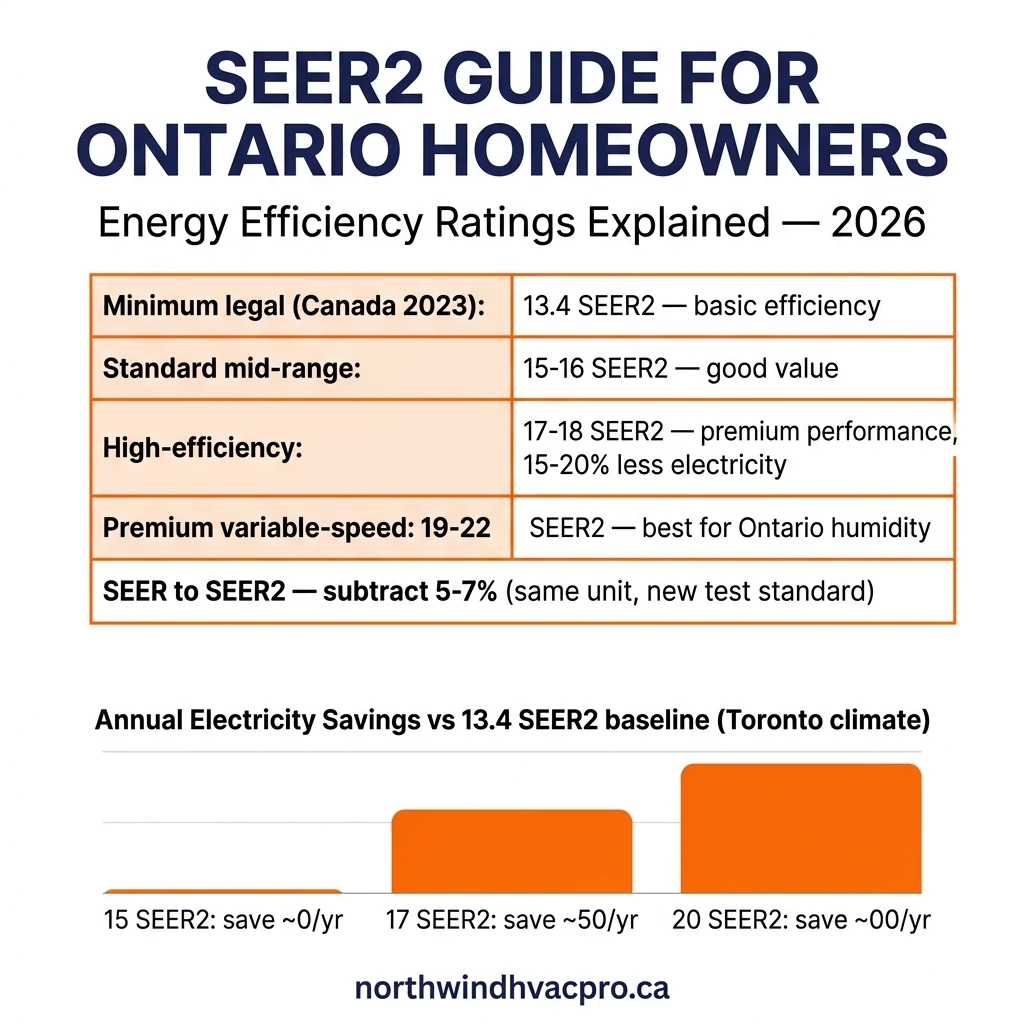
Canada follows Natural Resources Canada (NRCan) efficiency standards, which are closely aligned with the US DOE standards. As of 2023, the minimum SEER2 for new central AC equipment sold in Canada is 13.4 SEER2 for split systems in most climates. Equipment below this threshold can no longer be installed as a new system, though existing units can still be repaired.
In practice, most mid-range residential equipment sold in the GTA in 2026 falls in the 15 to 18 SEER2 range. Budget equipment starts at 14 to 15 SEER2. High-efficiency systems with variable-speed compressors can reach 20 to 24 SEER2.
When higher SEER2 pays off
Higher SEER2 translates directly to lower electricity consumption for the same amount of cooling. Whether that efficiency premium pays off financially depends on how much you run the AC, your local electricity rate, and how long you plan to stay in the home.
A rough calculation: a 3-ton AC system running 1,000 hours per cooling season in a Toronto home will use approximately 3,000 kWh at SEER2 14 and approximately 2,200 kWh at SEER2 19 (assuming a 12,000 BTU/ton load). At Ontario residential rates of roughly $0.15 per kWh, that is a $120 annual difference. Over 15 years, the higher-efficiency unit saves about $1,800 before accounting for inflation or rate increases. If the premium for the higher-efficiency unit is more than $1,800, the math does not favour the upgrade on energy savings alone.
Where higher SEER2 clearly pays off: homes that run AC heavily for 4 or more months per year, large homes with high cooling loads, homes in areas with high electricity rates, and homeowners who plan to stay in the house long-term. For a smaller home with moderate AC use, the mid-range efficiency tier often gives the best value.
SEER2 and heat pump ratings
Heat pumps use the same SEER2 metric for cooling efficiency, plus HSPF2 (Heating Seasonal Performance Factor) for heating. HSPF2 works similarly: higher is more efficient. A heat pump with HSPF2 9 or higher and SEER2 16 or higher is generally considered a solid choice for Ontario’s climate, where heating performance matters as much as cooling.
Cold-climate heat pumps designed for Ontario winters (rated to -15C or -25C operation) typically have lower SEER2 ratings than non-cold-climate units, because the refrigerant system is designed for extreme cold rather than optimized for cooling efficiency. This is the right trade-off for a GTA home, and the heating savings in winter more than compensate for the slightly lower cooling efficiency.
Practical buying guidance for GTA homeowners
For most GTA homes replacing a standard central AC: a SEER2 15 to 17 unit from a reputable brand like Carrier, Lennox, Trane, Goodman, or KeepRite will serve well and represent a good balance of upfront cost and operating efficiency. Go higher if you run your AC heavily or if the incremental cost is modest.
Ask the contractor to confirm: (1) the SEER2 rating specifically, not the older SEER number; (2) whether the equipment is ENERGY STAR certified; and (3) what rebates if any are available for the specific model. Some high-efficiency units qualify for Enbridge rebates; others do not. That can tip the economics in favour of a higher-efficiency model even when the upfront premium looks large.
Service areas for AC installation
- Vaughan
- Mississauga
- Brampton
- Markham
- Richmond Hill
- Scarborough
- Etobicoke
- Aurora and Newmarket
- Oakville and Burlington
- Ajax, Pickering, and Whitby
Book ac installation or replacement in the GTA
NorthWind installs central AC and heat pump systems across the GTA. All systems meet current SEER2 minimums. Free estimates on all AC and heat pump installations.
