 Proudly Canadian


 Home
Home Cooling
 Heating
 Heat Pumps
 Air Quality
 Other
Other
Learning how to balance airflow between rooms solves one of the most common comfort complaints in GTA forced-air homes. If some rooms in your home are noticeably warmer or colder than others, and the HVAC system is running normally, you have an airflow distribution problem. This is very common in GTA homes, particularly in two-story houses where the upper floor runs hot in summer and cold in winter, or in homes where renovations have added rooms without adjusting the duct system.
This guide covers the most common causes of uneven airflow, the DIY checks you can do yourself, and when the problem requires a duct technician. It also covers what balancing actually involves and what it costs in the GTA.
In this article
Common causes of uneven airflow
Undersized or incorrectly designed ductwork
The most fundamental cause is ductwork that was not properly designed for the home. A duct system needs to deliver the right volume of air to each room based on that room’s heat load — its size, window area, insulation, and sun exposure. When ductwork is sized by rule of thumb instead of by a proper Manual D calculation, some rooms get too much air and others get too little.
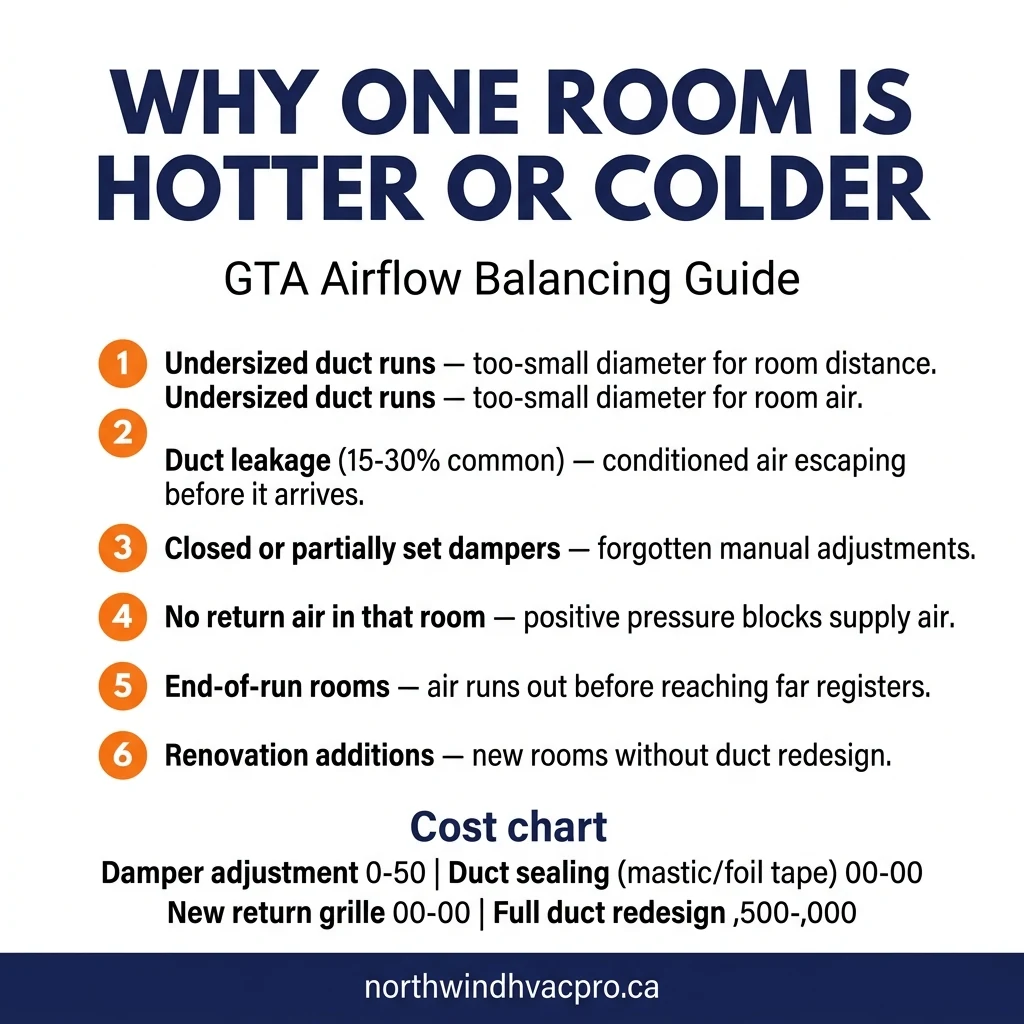
This is especially common in older GTA homes that have had additions or renovations. Adding a room withou t modifying the duct system means the existing duct runs now have to push air further, and rooms at the end of long duct runs typically receive less flow.
Leaky ducts
Duct leakage is extremely common in residential systems and has a direct impact on airflow distribution. If 20 percent of the air from a supply run leaks out before reaching the register, that room gets 20 percent less than it should. Duct leakage rates of 15 to 30 percent of system airflow are not unusual in older homes, especially in attic or crawlspace duct runs where joints and connections have been exposed to temperature cycles for years.
Duct sealing — using mastic sealant or foil tape (not regular duct tape, which fails quickly) on all joints and connections — is one of the most cost-effective HVAC improvements in older homes. It improves both airflow distribution and system efficiency.
Closed or partially open dampers
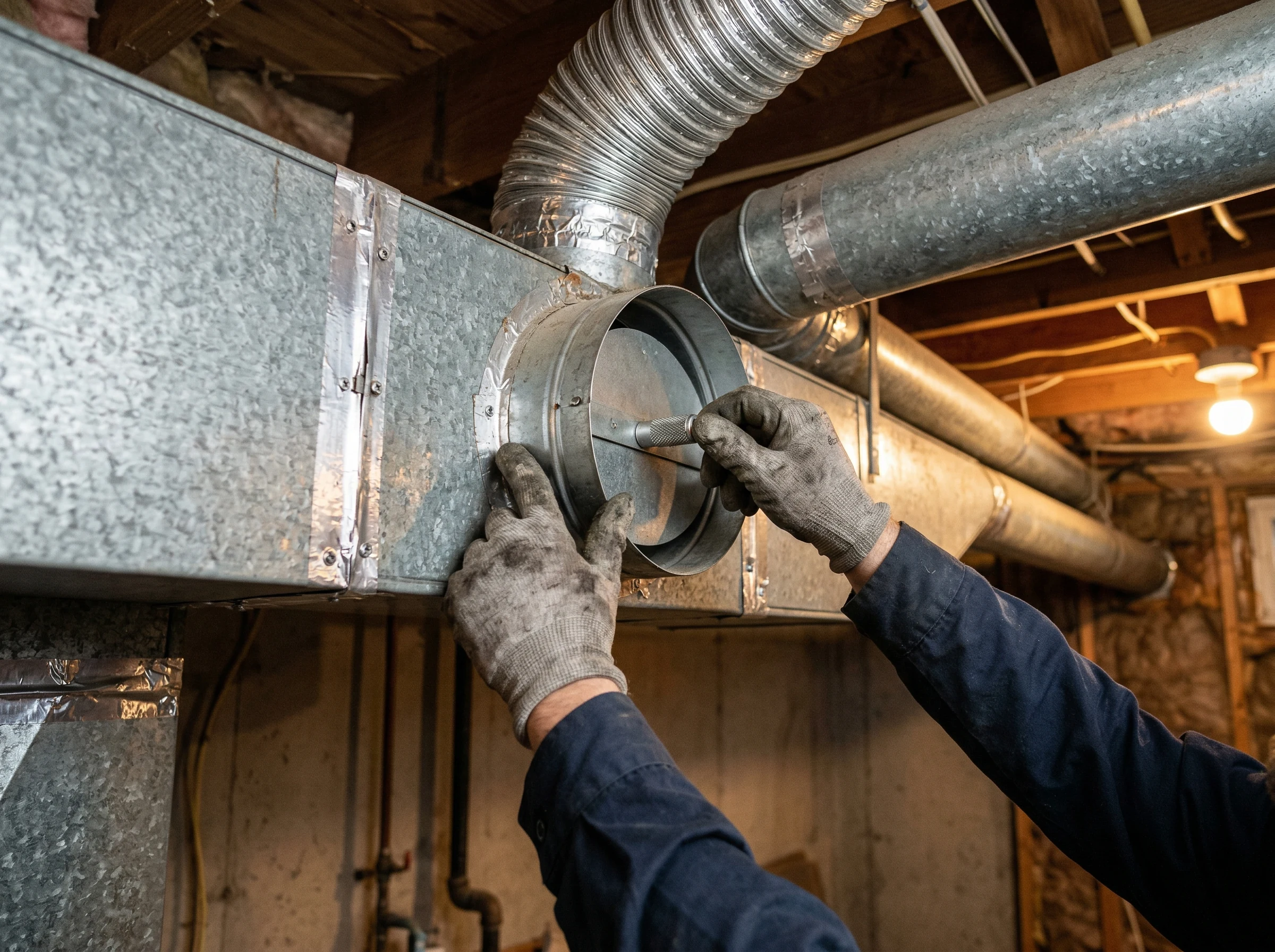
Most duct systems include adjustable dampers in the main trunk lines or branch runs. These are levers or plates that can be adjusted to restrict or increase flow to specific zones. In many homes, the original installer set them and they have never been touched. If a damper that feeds one wing of the house has been partially closed, everything downstream of it will receive less air.
Locating and checking dampers is something a homeowner can do in accessible ductwork (basement, utility rooms). Round dampers have a lever that aligns with the duct when fully open and sits perpendicular when fully closed. Rectangular dampers have a similar indicator on the outside.
DIY checks before calling anyone
Before booking a duct technician, check these things yourself: (1) Make sure all supply vents are fully open. Partially closed registers are a frequent cause of low airflow in specific rooms. (2) Check that return air grilles are not blocked by furniture or drapes. The return needs clear access to pull air back to the furnace. (3) Replace the air filter. A clogged filter reduces total system airflow and makes distribution problems worse across the board. (4) In accessible basement ductwork, look for any obvious disconnected joints, holes, or separated flex duct sections.
If these checks do not solve the problem, the issue is deeper in the duct system.
What professional airflow balancing involves
A proper airflow balancing service starts with measuring actual airflow at each supply register using an anemometer or flow hood. The technician compares measured flow against the designed flow for each room and identifies which rooms are over-served and which are under-served.
From that baseline, adjustments are made by modifying dampers, sealing leaks, or in some cases modifying the duct runs. The goal is to bring each room to within 10 to 15 percent of its design flow. After adjustments, the registers are re-measured to confirm the improvements.
Zoned HVAC systems as a permanent solution
For homes where the duct design fundamentally cannot balance well — common in two-story homes with a single air handler — a zoning system provides a more definitive solution. Zoning uses motorized dampers controlled by multiple thermostats (one per zone) to direct conditioned air where it is needed at any given time. The upper floor can call for cooling while the main floor does not, and the system adjusts accordingly.
Zoning costs $1,500 to $3,500 depending on the number of zones and whether significant ductwork modifications are needed. For homes with persistent comfort complaints in specific areas that simple balancing cannot solve, it is worth discussing with a technician.
Airflow balancing costs in the GTA
Typical costs for airflow-related services in 2026:
| Service | Estimated cost (GTA) |
|---|---|
| Duct inspection and leak assessment | $150 to $300 |
| Duct sealing (typical home) | $400 to $900 |
| Damper adjustment and balancing | $200 to $500 |
| Duct modification (add or resize branch) | $400 to $1,200 per run |
| Basic zoning system (2 zones) | $1,500 to $2,500 |
Service areas for ductwork service
- Vaughan
- Mississauga
- Brampton
- Markham
- Richmond Hill
- Scarborough
- Etobicoke
- Aurora and Newmarket
- Oakville and Burlington
- Ajax, Pickering, and Whitby
Book ductwork or airflow service in the GTA
NorthWind diagnoses and corrects airflow issues in GTA homes, from simple damper adjustments to full duct redesigns. Free estimates on all ductwork services.
