 Proudly Canadian


 Home
Home Cooling
 Heating
 Heat Pumps
 Air Quality
 Other
Other
Knowing how to improve indoor air quality at home starts with understanding what your HVAC system can actually do about it. Most GTA homeowners spend the majority of their time indoors, yet indoor air is often two to five times more polluted than the air outside. The sources are familiar: dust mites, mold spores, pet dander, VOCs from cleaning products and furniture, and combustion byproducts from gas appliances. What is less obvious is that your HVAC system is the most practical tool you have for addressing most of it.
This guide covers the main HVAC-based approaches: upgraded filtration, UV air purification, whole-home humidity control, and heat recovery ventilation. Not every home needs all of these, but understanding what each does helps you decide where the money is best spent.
In this article

Upgrade your air filter first
MERV ratings explained
MERV (Minimum Efficiency Reporting Value) ratings run from 1 to 16 for residential systems. A MERV 1 to 4 fibreglass filter catches large debris but very little else. A MERV 8 filter catches pollen, dust mites, and mould spores. A MERV 11 to 13 filter also captures fine particles, smoke, and some bacteria. For most GTA homes, a MERV 11 or 13 pleated filter is the practical sweet spot.
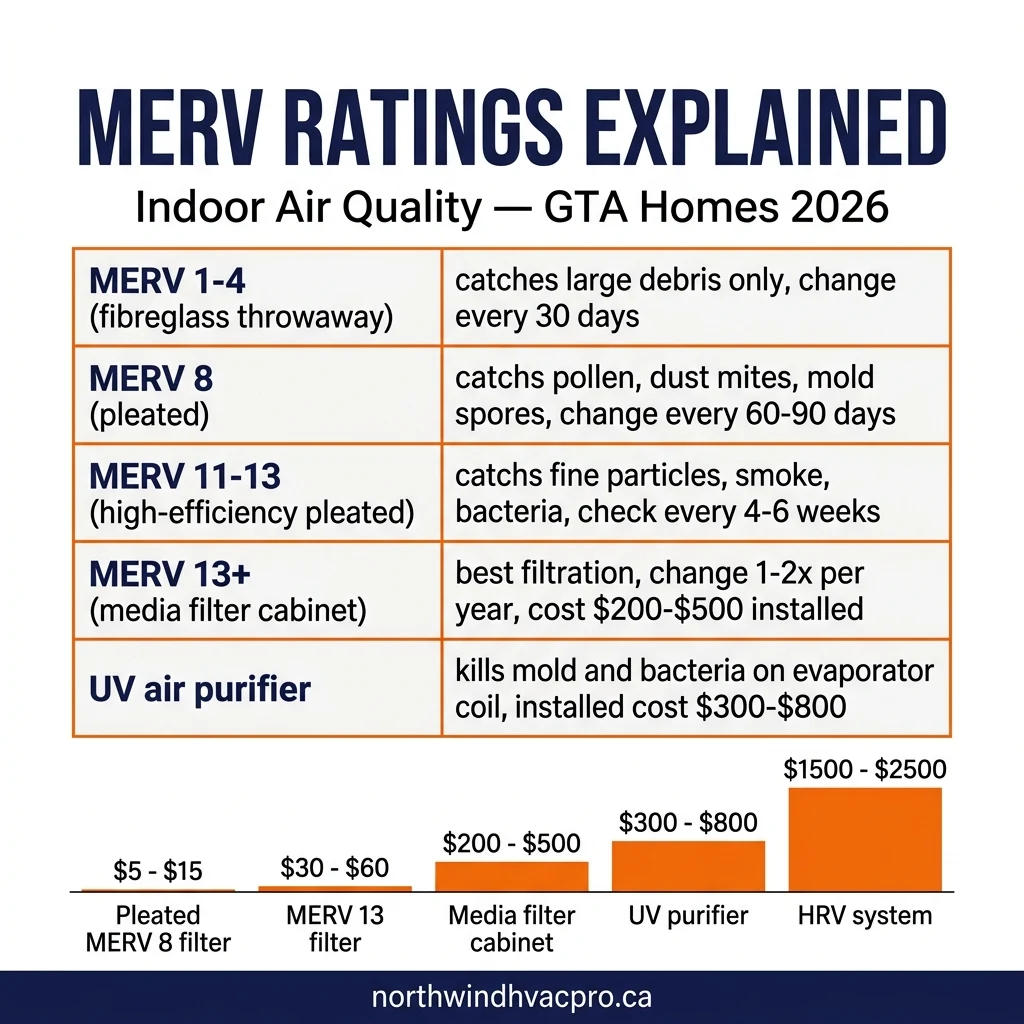
The catch is that higher-MERV filters load up faster. A MERV 13 filter left in for six months is almost as bad as a MERV 1 that is current. Check it monthly during the heating or cooling season and change it before it looks grey and matted.
Whole-home media filters
A 4 to 5-inch media filter cabinet installed at the air handler provides MERV 11 to 16 filtration with a much larger surface area. Because of the greater surface area, they load up more slowly and typically only need changing once or twice a year. Installed cost is roughly $300 to $600. For families with allergies or asthma, this is one of the better air quality investments available.
UV air purification systems
How UV-C light works in an HVAC system
UV-C light at 254 nanometres disrupts the DNA of microorganisms, preventing them from reproducing. A UV air purifier installed on the evaporator coil or in the supply duct irradiates passing air, reducing mould, bacteria, and some viruses. The evaporator coil itself is a damp environment where mould grows readily, and homes with recurring musty smells from the AC are prime candidates for a coil-mounted UV unit.
UV systems do not filter particles. They complement filtration rather than replace it. A UV purifier paired with a MERV 11 filter addresses both particulate and biological contamination. See our UV air purification service page for what NorthWind installs across the GTA.
Photocatalytic oxidation units
PCO (photocatalytic oxidation) units use UV light combined with a titanium dioxide catalyst to break down VOCs, odours, and chemical contaminants. These are more expensive at $800 to $1,400 installed, but are worth considering in homes with chemical sensitivities, new construction off-gassing, or significant cooking and cleaning-related odours.
Whole-home humidity control
Humidity affects air quality in both directions
Above 50 percent relative humidity in summer, mould and dust mite growth accelerates and the house feels hotter than the thermostat reads. Below 30 percent in winter, mucous membranes dry out, making cold and allergy symptoms worse. GTA winters are particularly dry, and forced-air heating makes it worse by recirculating the same dry air.
A whole-home humidifier connected to the furnace adds moisture during the heating season. A whole-home dehumidifier operates in summer to remove excess moisture. Standalone units handle a single room. Whole-home systems manage the entire house without requiring attention once set up correctly.
HRV and ERV ventilation
Why tight modern homes need mechanical ventilation
Modern homes are built tighter than older homes, which is good for energy efficiency but bad for air quality. Without adequate fresh air exchange, pollutants and CO2 accumulate. An HRV (heat recovery ventilator) brings in fresh outdoor air while transferring heat from the outgoing stale air, so you get ventilation without the energy penalty of simply opening a window in January.
An HRV installation on an existing forced-air system typically costs $1,200 to $2,500 depending on the layout and ductwork complexity. For homes with persistent stuffiness, elevated CO2, or lingering odours, it is the most effective air quality investment available. An ERV (energy recovery ventilator) does the same thing but also transfers moisture, making it a better choice for very dry climates or winter months.
What each approach actually costs
Rough costs for GTA homeowners in 2026:
| Upgrade | Estimated cost (installed) |
|---|---|
| MERV 11 to 13 pleated filter (DIY) | $15 to $40 per change |
| Whole-home media filter cabinet | $300 to $600 |
| UV air purifier (coil or duct) | $400 to $900 |
| Whole-home humidifier (bypass type) | $500 to $900 |
| Whole-home dehumidifier | $1,200 to $2,200 |
| HRV system installation | $1,200 to $2,500 |
Service areas for air quality upgrades
- Vaughan
- Mississauga
- Brampton
- Markham
- Richmond Hill
- Scarborough
- Etobicoke
- Aurora and Newmarket
- Oakville and Burlington
- Ajax, Pickering, and Whitby
Book air quality assessment in the GTA
NorthWind installs UV systems, media filters, HRV units, and whole-home dehumidifiers across the GTA. Free estimates on all indoor air quality upgrades.
