 Proudly Canadian


 Home
Home Cooling
 Heating
 Heat Pumps
 Air Quality
 Other
Other
Why is the LED on your Goodman furnace flashing? Each pattern points to a specific fault, and the flashes tell you whether you’re looking at a 60-second filter swap or a service call. This guide decodes every Goodman furnace error code you’ll see on a current board, what it actually means, and which ones a homeowner can safely address. For everything that touches the gas valve, heat exchanger, or wiring, our furnace repair team handles it. Two-stroke fixes belong to homeowners. Anything inside the burner compartment belongs to a TSSA-licensed technician.
Read your code first, then decide what to do. Most flash-code panics in our Barrie service area turn out to be a clogged filter, a tripped float switch, or a dead thermostat battery. Three minutes of diagnosis can save a $179 emergency call.
In this article
How to read the diagnostic LED on a Goodman furnace
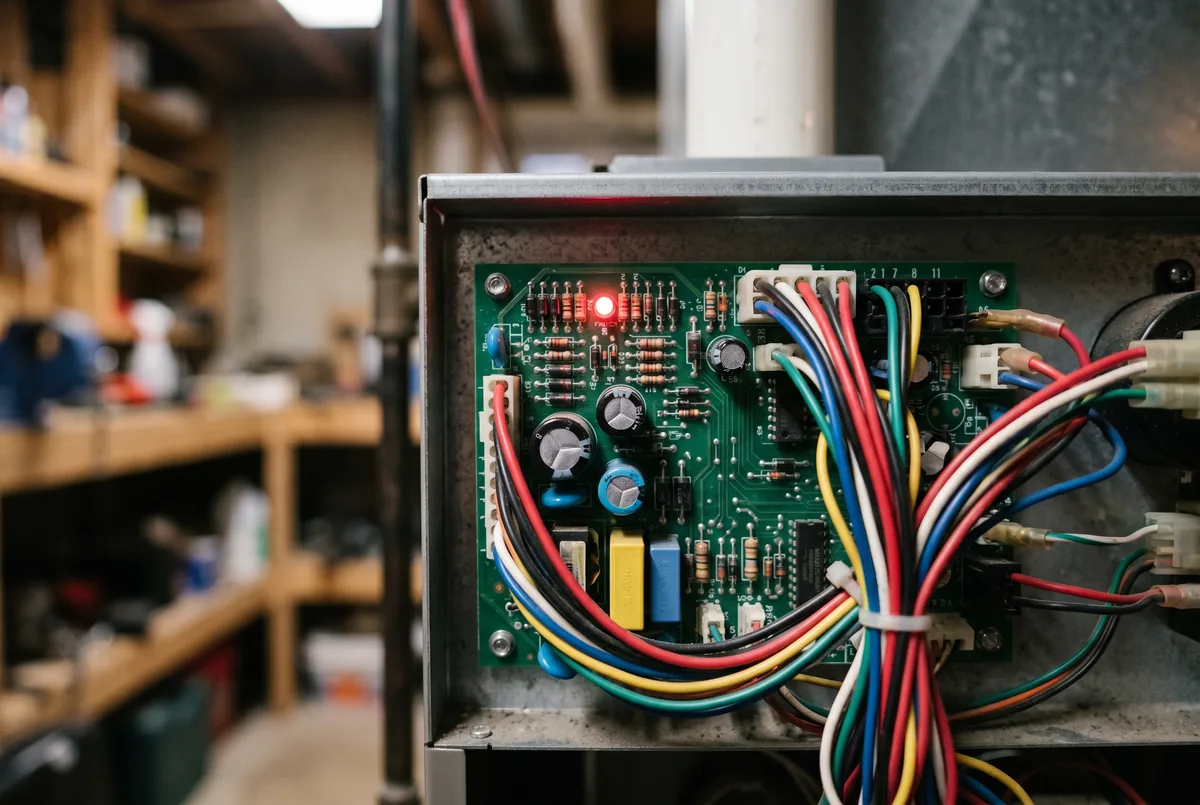
Every modern Goodman furnace has a small status LED on the integrated control board, visible through a small viewing window in the front access panel. It’s usually red or amber. The LED communicates in patterns: steady on, slow blink, fast blink, or a counted sequence (one flash, pause, two flashes, pause, repeat). Counting the flashes between pauses gives you the code.
Stand in front of the furnace and watch the LED for at least one full pause cycle (about 5 seconds of darkness). Count the flashes between two pauses. That number is your code. If the LED looks like it’s flashing erratically, you’re seeing two separate codes alternating, which means the board is reporting more than one fault at once. Note both numbers and call it in to a technician. That’s not a homeowner repair.
Pro tip
Take a 10-second video of the LED with your phone before calling for service. The technician can count the flashes from the video and arrive with the right replacement parts on the truck. That’s the difference between a one-visit fix and waiting two days for parts.
Full Goodman furnace error code list and what each one means
The exact codes vary slightly by board generation. The list below covers Goodman GMVC, GMVM, GMS, GMP, and Amana AMVC and AMS series boards used in Canadian installs from roughly 2010 through 2026. If your unit is older than that, the LED may not be present at all or may use a different code map. Pull the access panel and check the wiring diagram glued to the inside of the door. Goodman always includes a code legend on that label.
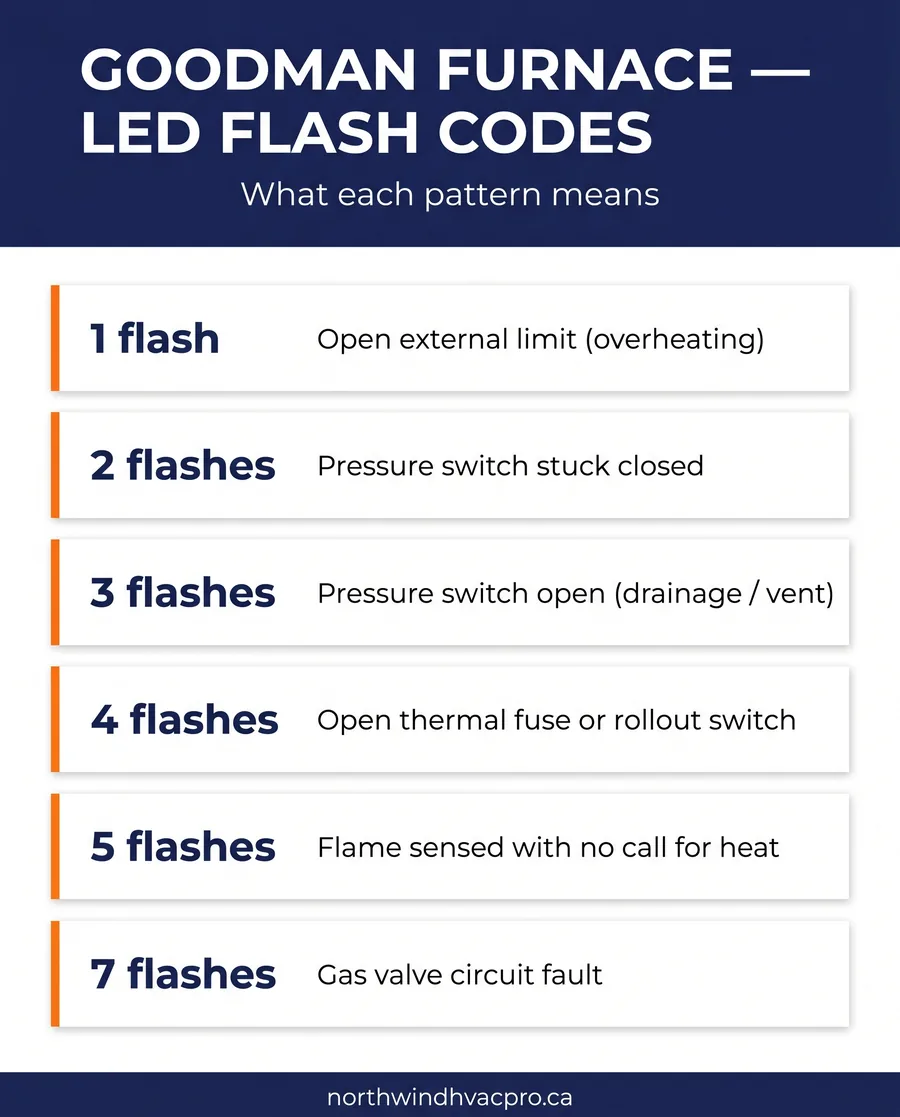
| LED pattern | What it means | Severity |
|---|---|---|
| Steady on | Normal operation, no fault | None |
| Slow flash | Normal call for heat in progress | None |
| Fast flash | Polarity reversed on incoming power | High |
| 1 flash | Open external limit switch (overheating) | Medium |
| 2 flashes | Pressure switch stuck closed | Medium |
| 3 flashes | Pressure switch open (drainage or vent issue) | Medium |
| 4 flashes | Open thermal fuse or rollout switch | High |
| 5 flashes | Flame sensed with no call for heat (gas valve leak) | High |
| 6 flashes | Ignition lockout after failed attempts | Medium |
| 7 flashes | Gas valve circuit fault | High |
| 8 flashes | Low flame sense signal (often dirty flame sensor) | Low |
| 9 flashes | Reversed polarity on incoming line voltage | High |
| 10 flashes | Limit circuit fault | High |
Why these errors actually happen
Most Goodman flash codes trace back to four root causes. Understanding the cause matters more than memorizing the code. The same single flash can come from a clogged filter, a closed supply register in too many rooms, or a failed limit switch. The code points you in a direction. The cause tells you what to do.
Airflow restrictions (most common cause)
If air can’t move through the heat exchanger fast enough, internal temperatures climb and the limit switch opens. That triggers a 1-flash code. The most common reason is a filter that hasn’t been changed in 4+ months. After that comes too many closed supply registers, blocked returns, or a failing blower motor. Check the filter first. It’s free and it solves about 35 percent of the 1-flash calls we see in Barrie homes.
Drainage and venting (high-efficiency furnaces)
High-efficiency Goodman furnaces (90 percent and up) produce condensate that drains through a small trap and tube. If the condensate trap clogs or the drain line freezes (which happens in Barrie when the furnace is in an unheated section of the basement), the pressure switch can’t see the proper draft and reports a 2 or 3 flash code. PVC vent terminations on the exterior wall also clog with snow, ice, or wasps. Check the outdoor termination on a clear day.
Flame sensor degradation
The flame sensor is a thin metal rod that sits in the burner flame and confirms ignition by measuring micro-amperage. Over time it builds an oxide coating that drops the signal below the board’s threshold. The 8-flash code (low flame sense) is almost always a dirty flame sensor on a furnace 4+ years old. A technician cleans it with steel wool or fine emery cloth in 90 seconds.
Wiring and electrical (the rare ones)
Reversed polarity (9-flash) is unusual but it happens after panel work, generator installs, or aftermarket inverter setups. The fix is at the panel, not the furnace. Don’t try to “rewire” the furnace itself.
What you can safely fix yourself
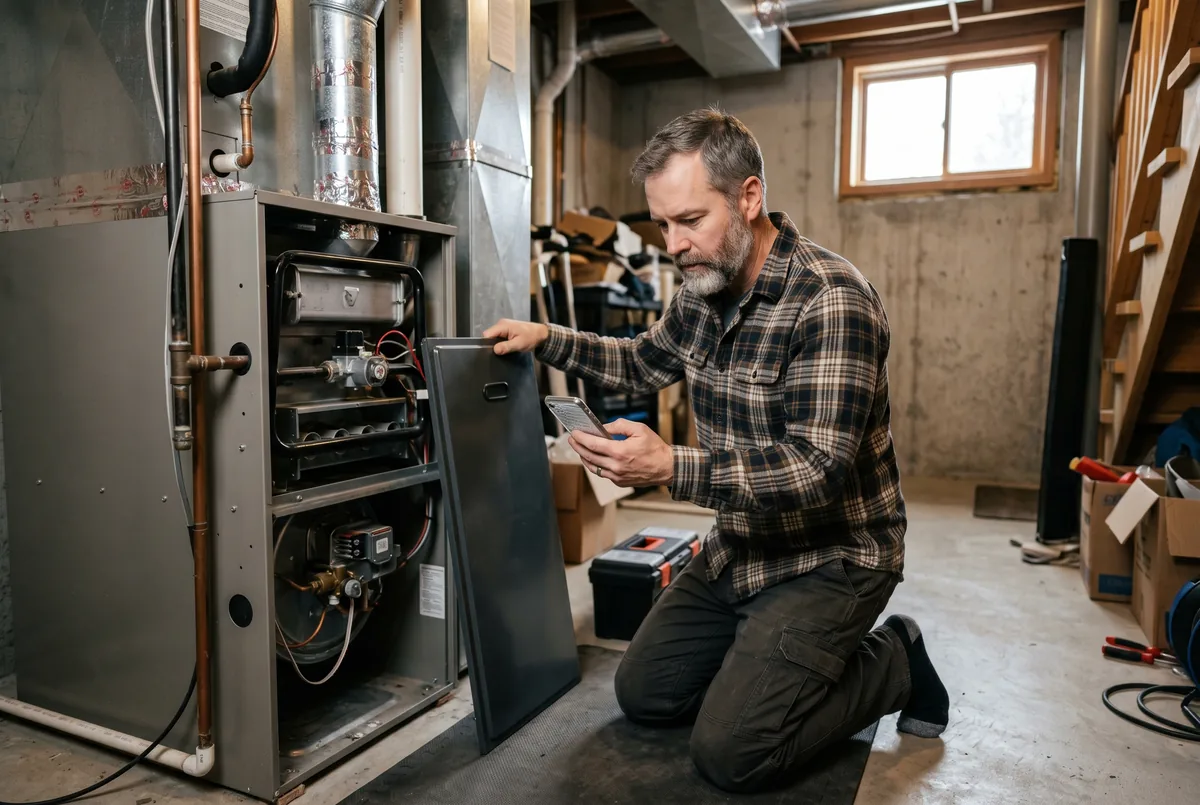
A handful of Goodman flash-code situations are fair game for a homeowner with basic tools. None of them involve opening the burner compartment, touching the gas valve, or working on wiring. Anything beyond this list is technician territory.
- Replace the air filter. Turn the thermostat off, open the filter compartment (usually next to the return air duct or inside the cabinet near the blower), note the size printed on the frame, slide in a new one with the airflow arrow pointing toward the furnace. Restart the system. This solves a startling percentage of 1-flash codes.
- Open all supply registers. Walk through every room and confirm supply registers are open and not blocked by furniture. Aim for at least 80 percent of supply area unrestricted. Closing too many registers raises static pressure and trips limits.
- Check the outdoor PVC vent termination. On 90 percent and higher furnaces there’s a white PVC pipe coming out an exterior wall. Clear any snow, ice, leaves, or insect nests blocking it. Don’t push anything down the pipe. Just clear the visible opening.
- Check the condensate drain line. Trace the small clear or white tube from the furnace to where it drains (usually a floor drain or condensate pump). If you see standing water in the trap or hear gurgling, it’s clogged. Many homeowners can pour a cup of hot water plus a tablespoon of vinegar through the trap to clear minor sludge. If that doesn’t restore drainage, call for service.
- Reset the furnace once. Turn the furnace disconnect switch off, wait 60 seconds, turn it back on. If the same code returns within 5 minutes, stop and call. Repeat resets just stress the ignition system.
- Check the thermostat. Heat mode, set point above current room temperature, fresh batteries. A 5-flash “flame sensed with no call for heat” can sometimes trace back to a thermostat sending intermittent signals.
When to stop and call a technician
Some Goodman codes are not negotiable. If you see any of the following, stop, don’t reset repeatedly, and book a service call. We’ve seen too many basement fires and gas leaks from homeowners who kept hitting the reset button on a clear warning.
Red flag: stop and call
- 4 flashes (open thermal fuse or rollout switch). A rollout switch trips when flame escapes the burner box. That’s a sign of a cracked heat exchanger or blocked combustion air. Continued operation risks carbon monoxide.
- 5 flashes (flame sensed without a call for heat). Indicates a possible gas valve leak. Shut off the gas at the furnace shutoff valve and call immediately.
- 7 flashes (gas valve circuit fault). Anything with the gas valve requires a TSSA-licensed G1 or G2 technician. No exceptions.
- Repeated 1 flashes after filter change. If overheating persists after a fresh filter, the blower motor or limit switch may be failing. Continued operation can damage the heat exchanger.
- Smell of gas at any time. Don’t restart. Don’t use any electrical switches. Leave the building, then call Enbridge Gas at 1-866-763-5427 (24/7). For an active gas leak, call 911 first.
Resetting a 4 or 5 flash code repeatedly is the worst thing you can do. The board cleared the lockout for a reason. Forcing it past that point on a unit reporting flame rollout or a gas valve leak is how we end up writing condemnation tags. Better to spend a night under a comforter and call in the morning.
How to prevent the most common Goodman faults
About 70 percent of the Goodman flash-code service calls we run in Barrie and the wider Simcoe County area trace back to maintenance gaps that take ten minutes a year to address. None of these require a technician.
- Change the filter every 2 to 3 months. Set a phone reminder. Write the install date on the frame with a marker. Mid-season is when filters quietly clog and start tripping limits.
- Clear the outdoor PVC vent termination after every snowstorm. A 30-second walk-around in winter prevents 80 percent of the 3-flash pressure switch faults.
- Have the condensate trap cleaned annually. A licensed technician does this during a yearly maintenance visit. Costs $150 to $250 for the full inspection.
- Have the flame sensor cleaned every 2 years. Bundled into yearly maintenance. The 8-flash code is preventable.
- Don’t close more than 20 percent of supply registers. Closing rooms to “save energy” backfires. The pressure spike trips limits.
- Replace the thermostat batteries annually. A weak signal from the thermostat causes false flame-sense codes. Pick a date you’ll remember (clocks-fall-back is a good one).
Download the Goodman flash code reference card
A printable two-page PDF with every Goodman LED flash pattern, what each one means, and the homeowner-safe fixes to try before calling. Stick it on the inside of your furnace room door.
NorthWind HVAC services Goodman, Amana, and most major furnace brands across Innisfil, Barrie, and the Greater Toronto Area. If your code returns after a filter change and a single reset, book a furnace service call and reference the flash count when you call. We’ll send a TSSA-licensed technician with the right replacement parts on the truck.
Frequently asked questions
Sources and references
- Technical Standards and Safety Authority – TSSA gas technician licensing and fuel safety
- Government of Canada – Environment Canada services on indoor air and combustion safety
- Natural Resources Canada – Energy efficiency for Canadian homes including furnace operation
- City of Barrie – Barrie planning and building information
Emergency contacts
- Gas leak or gas smell: Leave the building immediately. Do not use any electrical switches or phones inside. Once outside, call Enbridge Gas emergency line: 1-866-763-5427 (24/7). For active risk, call 911.
- Carbon monoxide alarm: Leave the building, get fresh air, call 911.
- TSSA fuel-safety incident reporting: tssa.org
This information is for general awareness. In any emergency involving gas, carbon monoxide, or electrical hazards, evacuate first and call emergency services. Do not re-enter until cleared by authorities.
Please note: The information in this article is for general guidance only. NorthWind HVAC is not liable for outcomes from actions taken based on this content. Gas furnace work involves combustion, electricity, and pressurized fuel lines. In Ontario, all gas appliance work must be performed by a TSSA-licensed G1 or G2 gas technician. Unlicensed gas work is illegal under the Technical Standards and Safety Act, 2000. Electrical work requires an ESA-permitted electrician. Refrigerant handling requires Environment Canada certification. Always confirm with a licensed professional for your specific situation.
What to do next
- Read the LED. Note the flash count.
- Check the filter, registers, and outdoor vent.
- Reset once. If the code returns within five minutes, call.
NorthWind HVAC handles Goodman, Amana, and every other major furnace brand across Barrie, Innisfil, and the GTA. Same-week service in heating season.
