 Proudly Canadian


 Home
Home Cooling
 Heating
 Heat Pumps
 Air Quality
 Other
Other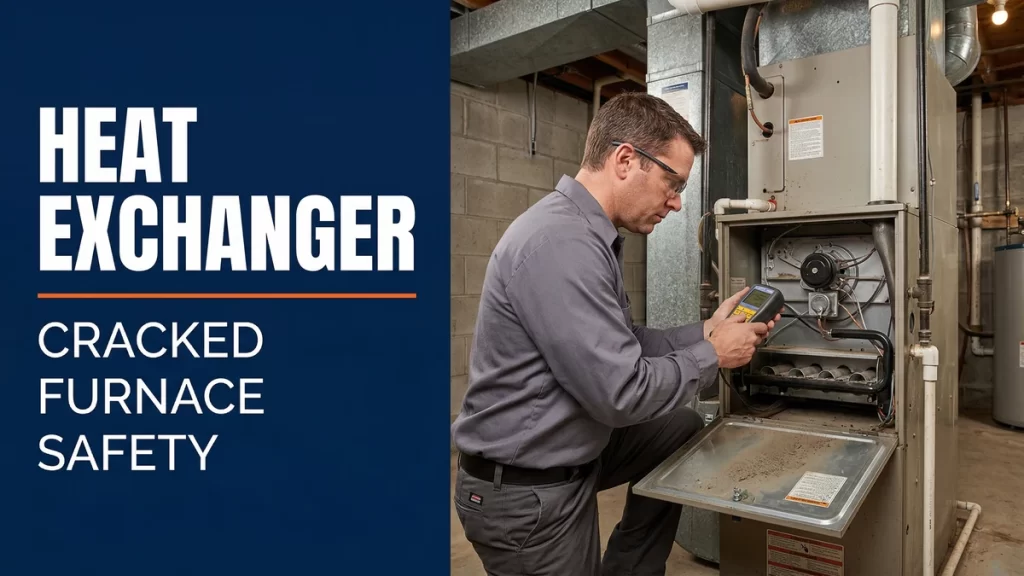
A cracked furnace heat exchanger is the most serious safety issue in a residential heating system, and it can develop slowly in any furnace over 10 years old across the GTA. A cracked heat exchanger is one of those furnace diagnoses that tends to prompt questions, skepticism, and sometimes a second opinion. That is understandable. It is serious and expensive, and there are contractors who use it as a pretense to push a full furnace replacement when a repair might suffice. But a genuine crack in the heat exchanger is a real safety issue, not just a mechanical problem. Here is what you need to know.
This post covers what the heat exchanger does, what causes cracks, how they are detected, what symptoms to watch for as a homeowner, and what your options are if a technician says yours is cracked.
In this article
What the heat exchanger does
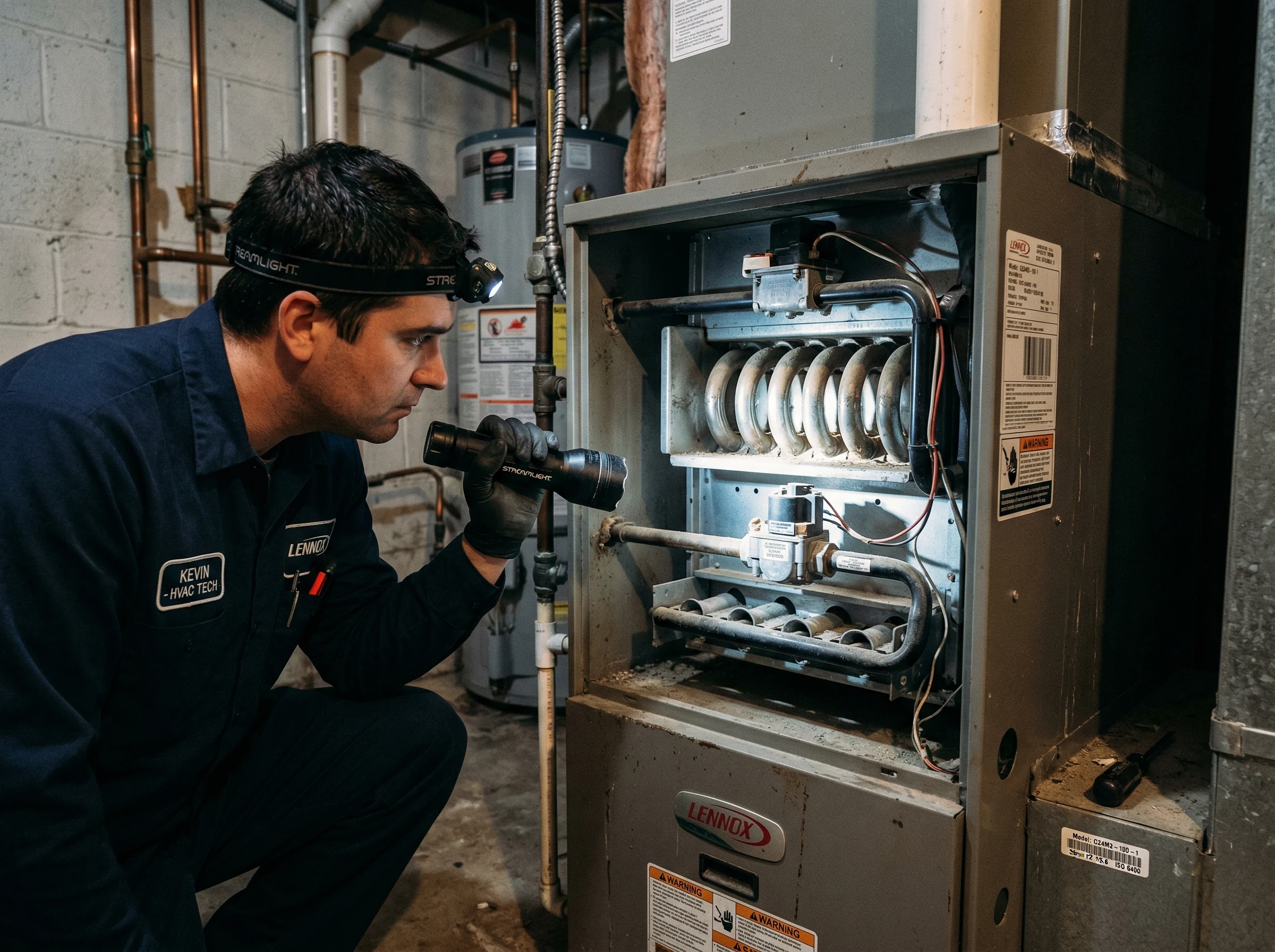
The heat exchanger is the metal component inside the furnace that separates the combustion gases from the air that circulates through your home. Combustion happens inside the heat exchanger. The hot metal surface heats the circulating air on the outside of the exchanger. The combustion gases exit through the flue. As long as the heat exchanger is intact, combustion gases never mix with the air supply.
When the heat exchanger cracks, that separation fails. Combustion gases including carbon monoxide can escape from the cracked area and mix with the air being distributed through the house. CO is odorless, colorless, and potentially fatal at high concentrations. This is why a cracked heat exchanger is treated as a safety issue rather than just a repair item.
What causes heat exchanger cracks
Thermal stress over time
The heat exchanger expands when the furnace fires and contracts when it cools. Over thousands of heating cycles, that repeated thermal stress fatigues the metal. Cracks typically develop in the areas of highest stress: bends, welds, and areas near the burner where temperature gradients are steepest. This is normal aging and is why most heat exchangers develop problems between 15 and 25 years of service.
Short-cycling and overheating
A furnace that short-cycles goes through more heating and cooling cycles per day than a properly operating furnace. Each cycle adds to the thermal fatigue. A furnace that has been short-cycling for years due to a dirty filter, an oversized unit, or a persistent airflow problem will develop heat exchanger fatigue faster than one that runs normal cycles.
Signs of a cracked heat exchanger
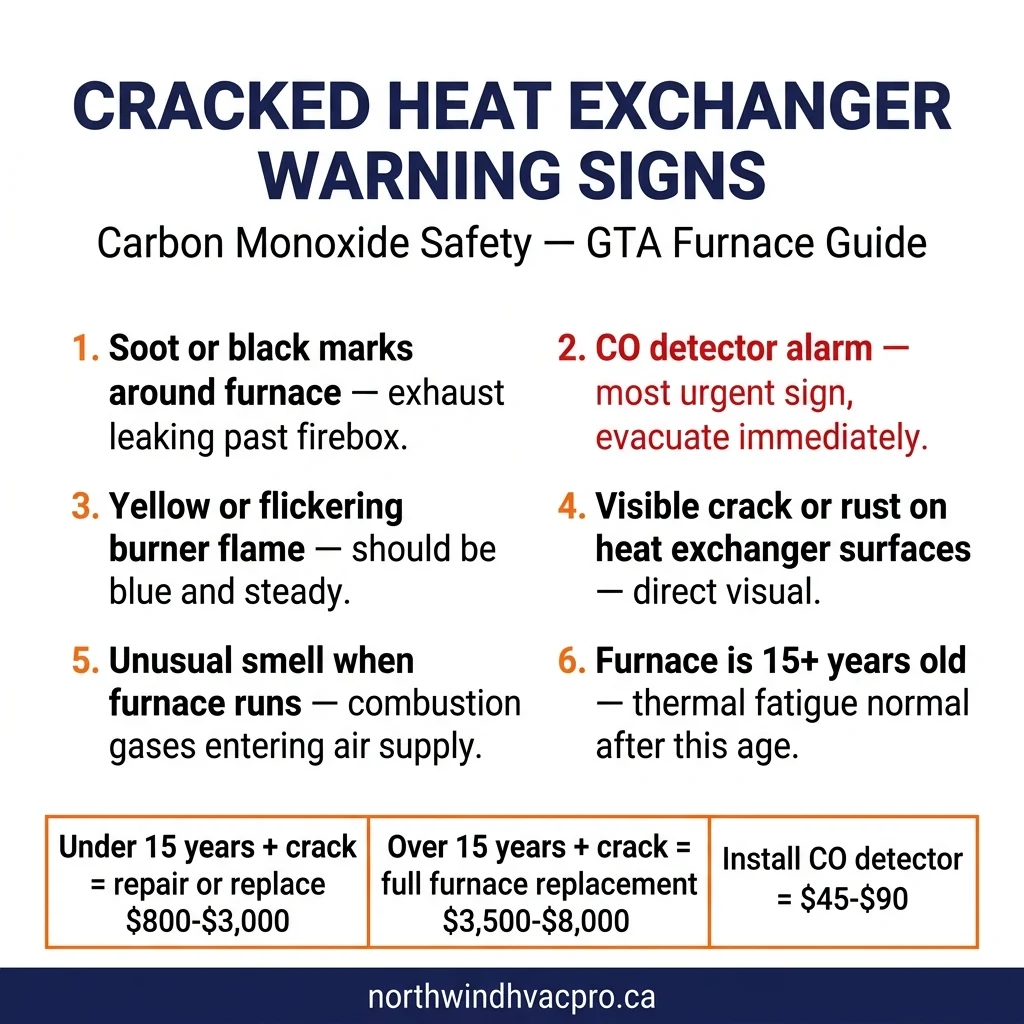
Physical symptoms homeowners can notice: (1) Your carbon monoxide detector activates. This is the clearest possible sign that something is wrong with combustion venting. If your CO detector goes off, turn off the furnace and call immediately. (2) Unusual odours when the furnace runs, particularly a faint formaldehyde or chemical smell. (3) Soot or black marks around the furnace or on the heat registers. (4) Family members experiencing headaches, nausea, or fatigue that resolves when they leave the house.
None of these symptoms are definitive on their own, but any one of them warrants a furnace inspection. A technician with a combustion analyser can confirm whether CO or combustion gases are present in the supply air.
How cracks are detected
Visual inspection through the burner compartment can identify obvious cracks, but small cracks in less accessible areas of the exchanger may not be visible without removing components. More reliable methods include: (1) Combustion analysis — measuring CO levels in the supply air while the furnace runs. If CO is present in the supply air, something in the combustion circuit is leaking. (2) Smoke or tracer gas testing — introducing a tracer at the burner and checking for leaks at the supply registers. (3) Camera inspection — a probe camera can view inside the heat exchanger sections to find cracks not visible from the outside.
If a contractor tells you your heat exchanger is cracked but only did a visual inspection through the burner viewing port, asking for a more thorough test is reasonable. However, if they found elevated CO in the supply air with a combustion analyser, that is a definitive finding.
Repair or replace?
Heat exchanger replacement is possible in many furnaces, but it is expensive: $600 to $1,500 for the part plus labour, on older furnaces that may not have ready parts availability. On a furnace that is 15 or more years old, replacement of the whole system is usually the more logical choice. The heat exchanger is not the only component that ages, and a furnace with a cracked exchanger at age 18 is also approaching end of life on the inducer motor, the control board, and the igniter.
If the furnace is 10 years old or newer and otherwise in good condition, heat exchanger replacement is worth considering. Get the specific replacement cost before deciding. Some exchangers cost $300 to $400 in parts and are straightforward to replace. Others are expensive and require extensive disassembly. Know the total cost before committing.
Service areas for furnace inspection
- Vaughan
- Mississauga
- Brampton
- Markham
- Richmond Hill
- Scarborough
- Etobicoke
- Aurora and Newmarket
- Oakville and Burlington
- Ajax, Pickering, and Whitby
Book furnace inspection or repair in the GTA
NorthWind offers same-week service across the GTA. Free estimates on all furnace inspection or repair service calls.

Written by
Oleksii Sitalo
Oleksii Sitalo is an HVAC professional with hands-on experience in heating, cooling, air conditioning, furnace systems, and home comfort solutions.
