 Proudly Canadian


 Home
Home Heating
 Cooling
 Heat Pumps
 Air Quality
 Other
OtherHVAC Tips and Tricks
How Long Does a Central Air Conditioner Last in Ontario?

Apr
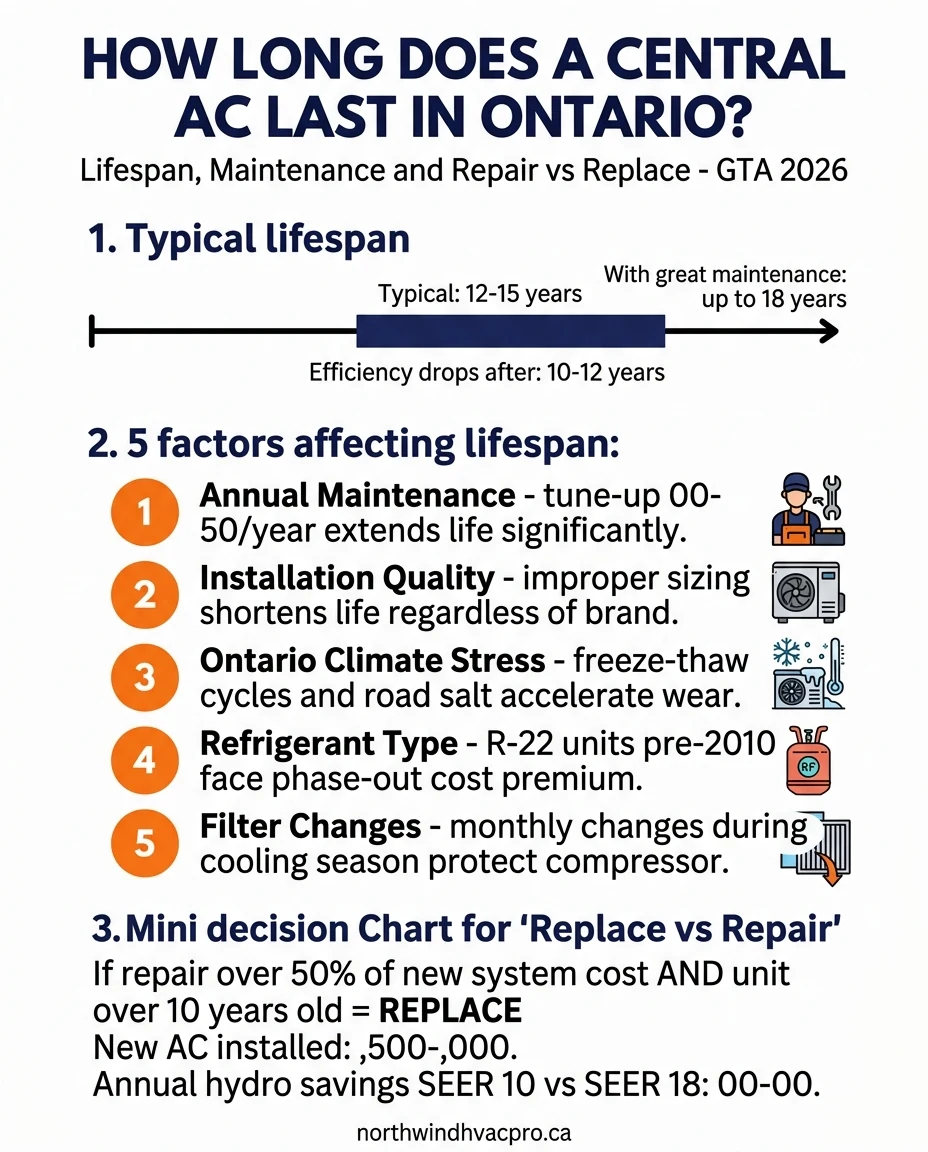
A central air conditioner in Ontario typically lasts 12 to 15 years with reasonable maintenance. Some units run past 15 years, but efficiency drops noticeably after the 10 to 12 year mark even when nothing has technically broken. The GTA climate is harder on outdoor equipment than most people realize: hot, humid summers, cold winters, road salt in the air, and freeze-thaw cycles all take their toll on the condenser unit and refrigerant lines over time.
If you are trying to figure out whether to repair your current unit or budget for a replacement, this guide covers what affects AC lifespan, what maintenance actually makes a difference, and what the signs are that a system is nearing the end of its useful life. If you already know you need service, book AC repair in the GTA or request a free estimate online.
In this article
This article is also available as a podcast. Hit play to listen while you work or commute.
What affects how long an AC lasts
Maintenance history
The single biggest factor in AC lifespan is whether the unit has received regular annual maintenance. A spring tune-up, typically $100 to $150, involves cleaning the coils, checking refrigerant levels, testing the capacitor and contactor, lubricating moving parts, and inspecting the electrical connections. Units that get this service every year consistently outlast units that go years without any attention. The cost of three tune-ups over three years is far less than the accelerated wear from skipping them.
The air filter matters too. A clogged filter restricts airflow across the evaporator coil, which causes the coil to freeze, forces the compressor to work harder, and shortens its life. Changing the filter every 1 to 3 months during the cooling season is the simplest thing a homeowner can do to extend system life.
Did you know?
According to HRAI (Heating, Refrigeration and Air Conditioning Institute of Canada), units that receive annual professional maintenance run an average of 3 to 5 years longer than comparable units that are serviced only when something breaks. That gap represents thousands of dollars in deferred replacement cost for a typical GTA homeowner.
Brand and installation quality
Not all residential AC systems are built to the same standard. Premium brands like Carrier, Lennox, and Trane consistently show longer service lives in field data compared to budget units. That said, a well-installed mid-tier unit will usually outlast a premium unit with a poor installation. Improper refrigerant charge at installation, undersized or oversized equipment, and duct systems that don’t match the unit’s airflow requirements all shorten equipment life regardless of brand.
If your AC was installed by whoever gave the lowest quote without a load calculation or proper commissioning, that history matters when you are trying to predict remaining lifespan.
Ontario climate stress
The GTA’s climate puts outdoor equipment through more thermal cycling than a unit in a milder region. A compressor that starts and stops hundreds of times per cooling season experiences mechanical stress on every startup. The freeze-thaw cycles in shoulder seasons affect the refrigerant lines, the base pan, and any exposed electrical connections. Salt from road spray in high-traffic areas accelerates corrosion on the condenser fins and cabinet.
None of this means Ontario ACs fail prematurely compared to the stated lifespan. It means the upper end of the lifespan range is harder to reach here than it would be in a milder climate, and why proper maintenance is not optional if you want to get full value from the unit.
Signs your AC is nearing end of life
Increasing repair frequency
One repair in a summer is usually just bad luck. Two or three repairs in the same season, or repairs in back-to-back summers, is the system telling you that multiple components are wearing out at the same time. This is common in units that are 10 to 14 years old. The compressor is still running but the capacitor, the contactor, and the refrigerant charge have all been serviced in recent years. At that point you are managing a declining asset rather than a functioning system.
A rough calculation: add up what you have spent on repairs in the past two years. If that number is approaching 40 to 50 percent of what a new system would cost, the math usually favours replacement, especially if the unit is already past 10 years old.
People often ask: is it worth repairing a 10 to 12 year old AC?
It depends on the repair cost relative to replacement. If the repair is under $500 and the unit otherwise runs well, fixing it usually makes sense. If the quote is $800 or more on a unit past 10 years, get a replacement quote at the same time before deciding. The 50 percent rule (below) gives a sharper framework for this calculation.
R-22 refrigerant (pre-2010 units)
Units manufactured before 2010 almost certainly use R-22 refrigerant, which has been phased out under federal regulations. R-22 is still available but at dramatically higher cost than R-410A, the current standard. A refrigerant recharge on an R-22 system can cost two to three times more than the same job on a modern system, and that premium will only increase as supply continues to shrink.
If your system uses R-22 and has a refrigerant leak, replacement is almost always the right call financially. You would be spending significant money on refrigerant for a system that is already 15-plus years old and approaching the end of its life regardless.
Pro tip
Not sure if your system uses R-22 or R-410A? Check the label on the outdoor condenser unit. It will state the refrigerant type directly. If you bought or moved into the home and the label is faded, a technician can confirm it in a few minutes at your next service call. Do not wait until you have a leak to find out.
Loss of efficiency vs SEER2 standards
Older systems were built to older efficiency standards. A unit installed in 2008 or 2010 might have a SEER rating of 10 to 13. Current minimum SEER2 standards for new equipment require significantly higher ratings, and modern mid-range systems often hit SEER2 18 to 22. That efficiency gap translates directly to your hydro bill every cooling season.
A rough estimate: an older system running at SEER 10 versus a new system at SEER 18 uses roughly 45 percent more electricity for the same cooling output. In a hot GTA summer with a large home, that difference can run $300 to $600 per season. Over 10 years, that is a meaningful offset against the cost of replacement.
When to replace vs repair
The 50 percent rule
The standard guideline: if a repair costs more than 50 percent of what a new system would cost, replacement is usually the better long-term decision. A new central AC in the GTA runs roughly $3,500 to $6,000 installed depending on size, efficiency, and brand. So a repair quote over $1,750 on a unit that is already 12 to 14 years old is usually a trigger to get a replacement quote at the same time.
The rule is imperfect because it ignores age. A $2,000 repair on a 4-year-old system is probably worth doing. The same repair on a 13-year-old system may not be, because the unit has limited remaining life and another repair is likely coming. Age and repair cost together give a more accurate picture than cost alone.
| Situation | Keep and repair | Replace |
|---|---|---|
| Age | Under 10 years | 12 years or older |
| Repair cost vs new unit | Under 30 to 40 percent | Over 50 percent |
| Refrigerant type | R-410A (current) | R-22 (phased out, costly) |
| Recent repair history | First or second issue | Recurring annual repairs |
| Efficiency (SEER) | SEER 14 or higher | SEER 10 to 13 (high hydro cost) |
| Furnace age | Furnace is newer (under 10 yrs) | Both AC and furnace are aging |
When multiple columns point to “replace,” the math almost always favours replacement. The only exception is a very expensive home where replacement costs are disproportionately high and the unit is not yet at 12 years.
Heat pump as an alternative to straight AC replacement
If you are replacing the AC anyway, a heat pump is worth serious consideration. A heat pump provides both cooling and heating, and current Ontario government programs offer meaningful rebates on qualifying installations. For homes where the furnace is also aging, replacing both with a heat pump system can make financial sense. See our guide to heat pump grants available in Ontario in 2026 for current amounts and eligibility.
Save your money
Ontario homeowners replacing qualifying central AC systems or heat pumps may be eligible for rebates through the Canada Greener Homes program or Enbridge Gas rebates. Ask your technician to confirm eligibility before selecting equipment. The right unit at the right efficiency tier can reduce both upfront cost and future hydro bills.
Download the free AC lifespan guide
Print this checklist and keep it with your HVAC equipment. It covers annual maintenance steps, the repair vs replace decision, and what to watch for as your system ages.
Estimate your savings with a new system
Use the calculator below to get a rough sense of how much you could save on hydro by replacing an older low-efficiency unit with a modern SEER2-rated system.
Estimate your hydro savings with a new AC
Compare your current system to a modern high-efficiency unit.
This is a rough estimate. Actual savings depend on home size, insulation, usage patterns, and your local hydro rate. NorthWind offers free in-home assessments to give you a more accurate picture.
Frequently asked questions
How long does a central air conditioner last in Ontario?
Most central AC systems in Ontario last 12 to 15 years with regular annual maintenance. Units that go without service or were undersized at installation tend to fall closer to the 10 to 12 year mark. A unit still running at 16 to 18 years is not unusual, but efficiency will have dropped enough that replacement usually makes financial sense.
Is it worth repairing an AC that is over 12 years old?
It depends on the repair cost relative to replacement. If the repair exceeds 40 to 50 percent of replacement cost on a unit past 12 years, replacement usually makes more financial sense. A $400 capacitor replacement on a 13-year-old unit is probably fine. A $1,500 compressor job on the same unit warrants getting a replacement quote first before authorizing the repair.
What is the difference between SEER and SEER2?
SEER2 is the updated efficiency standard introduced in 2023 using a more realistic test methodology. A SEER2 16 unit is roughly equivalent to a SEER 17 to 18 unit under the old rating. A SEER2 18 system typically cuts cooling energy use by 30 to 40 percent versus a SEER 12 unit installed a decade ago. When comparing equipment quotes, confirm all ratings use the same standard.
How much does a new central AC cost to install in the GTA in 2026?
A standard central AC replacement in the GTA typically runs $3,500 to $7,000 installed, depending on the brand, efficiency tier, and home size. Entry-level mid-tier brands at SEER2 16 sit at the lower end. High-efficiency systems from Lennox or Daikin at SEER2 20 or higher are at the upper end. Always confirm the quote includes refrigerant, permits if required, and full commissioning.
Can I get a rebate on a new AC or heat pump in Ontario?
Yes. The federal Canada Greener Homes program has offered rebates on qualifying heat pump installations, and Natural Resources Canada maintains current program details. Enbridge Gas also runs seasonal rebates on high-efficiency equipment. Confirm eligibility with your contractor before purchasing equipment.
Where we work in the GTA
NorthWind serves homeowners across the Greater Toronto Area:
Book AC repair or replacement in the GTA
NorthWind offers same-week service across the GTA. Free estimates on all ac repair or replacement calls.

Written by
Michael Torres
Certified AC Technician | HRAI Member
Michael Torres has been servicing central air conditioning and ductless systems in the GTA for over a decade. He is a member of the Heating, Refrigeration and Air Conditioning Institute of Canada (HRAI) and holds refrigerant handling certification under the Environmental Protection Act.
