 Proudly Canadian


 Home
Home Heating
 Cooling
 Heat Pumps
 Air Quality
 Other
OtherHVAC Tips and Tricks
What Does an AC Tune-Up Include? (And Is It Worth It in the GTA?)
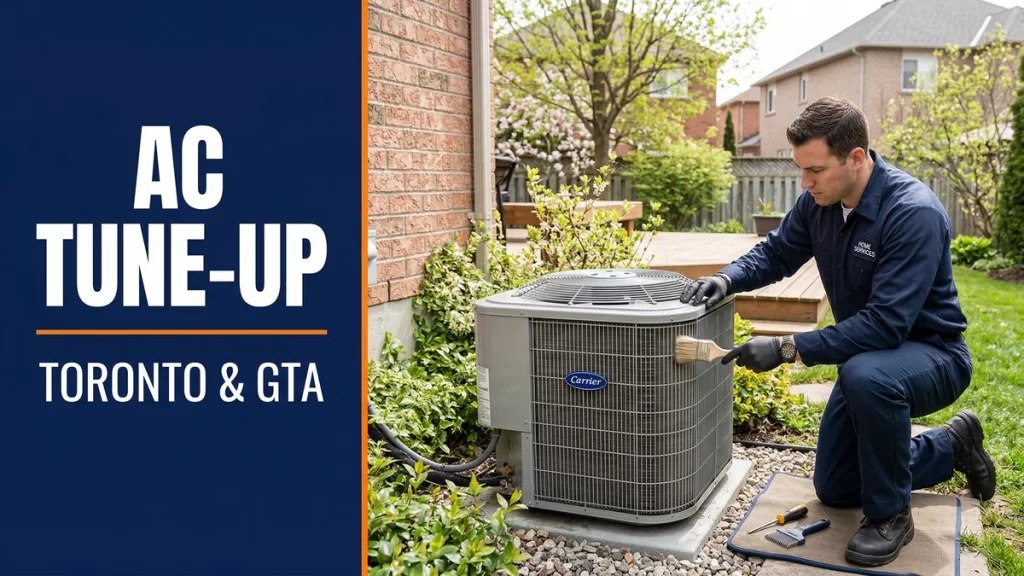
Apr
An AC tune-up is a scheduled preventive maintenance service, typically done in spring before the cooling season starts. It is not a repair. It is a set of checks and services designed to catch small problems before they become breakdowns, and to make sure the system is running at close to its design efficiency. Most homeowners who book regular tune-ups never deal with an emergency AC call in the middle of July.
Here is exactly what a thorough spring tune-up includes, what each step actually does for the system, and what it costs in the GTA right now. If your AC is already having issues, book AC repair here rather than a tune-up.
In this article
Listen to this article as a podcast
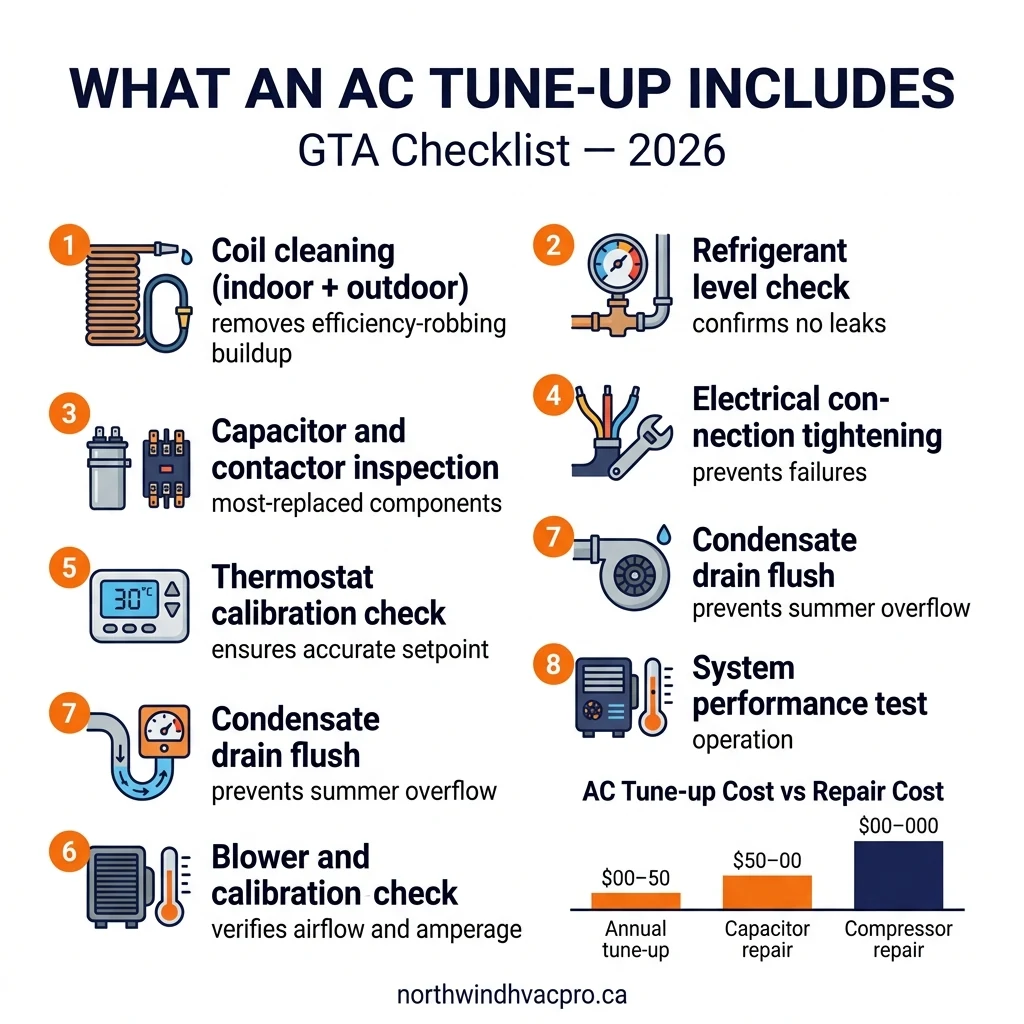
What a complete AC tune-up covers
Coil cleaning (indoor and outdoor)
The evaporator coil (indoor, over the furnace) and the condenser coil (outdoor unit) both accumulate dirt, dust, and debris over time. A dirty coil insulates against heat transfer, which means the system has to work harder to achieve the same cooling. Condenser coils in urban areas near highways or construction can get noticeably fouled in a single season.
Cleaning both coils is usually the most impactful single step in a tune-up. A technician will use coil cleaner and a soft brush or low-pressure wash on the condenser, and a no-rinse coil spray on the evaporator. After cleaning, you will often see a measurable improvement in how quickly the system cools the house.
Did you know?
According to ASHRAE, dirty condenser coils can reduce an AC system’s efficiency by up to 30 percent. In a typical GTA home running a 3-ton system, that efficiency penalty can add $100 to $200 to the annual hydro bill. A coil cleaning during a spring tune-up is often the single action with the highest immediate return on a dollar-for-dollar basis.
Refrigerant level check
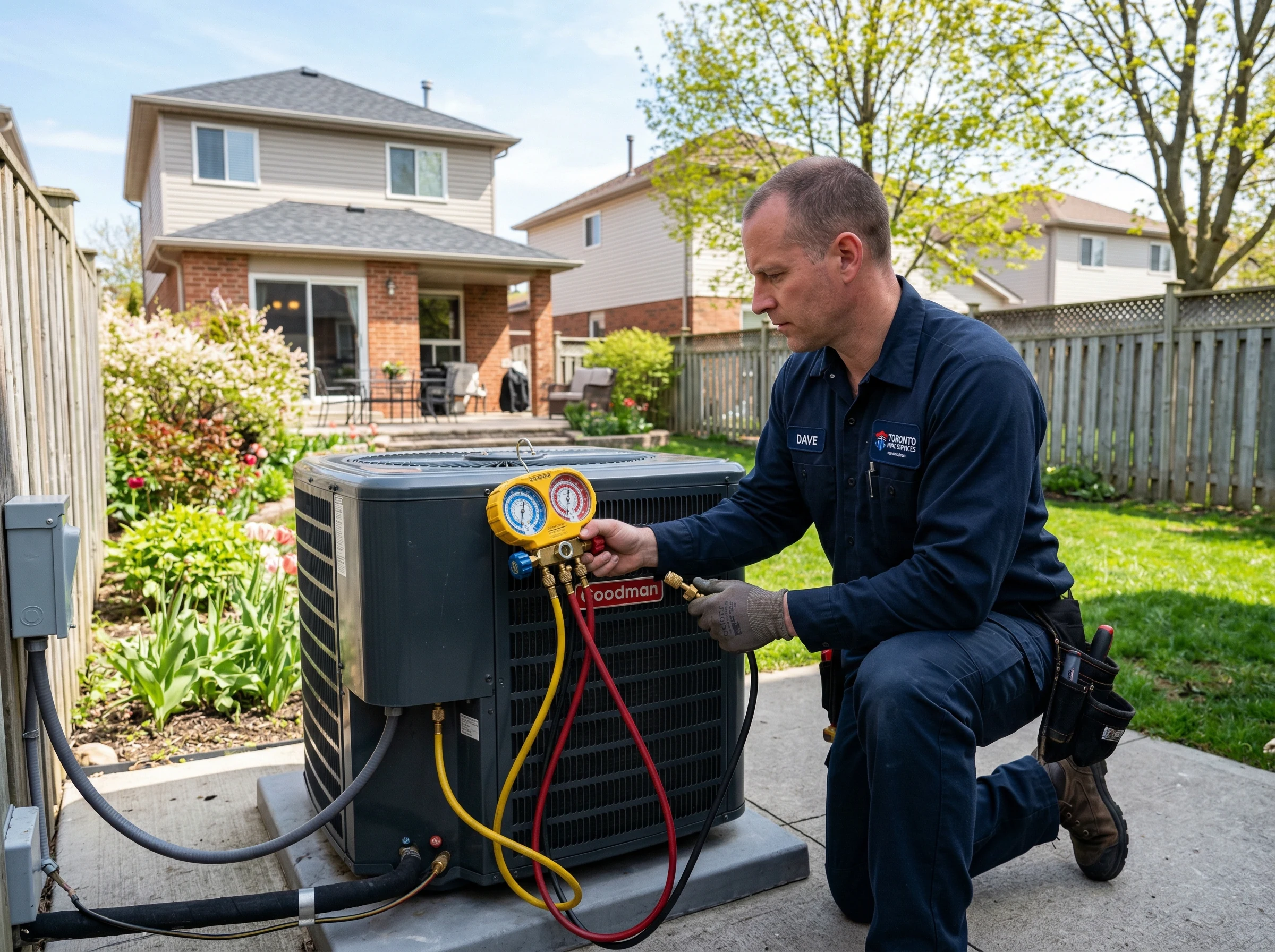
The technician checks the refrigerant pressure using manifold gauges and compares it against the manufacturer spec for the current operating conditions. A low reading indicates a leak somewhere in the system. Note: refrige rant does not get consumed. Low levels always mean a leak, not just normal depletion. If the pressure is low, topping it off without finding the source just delays the real repair.
If the system is on refrigerant spec, this check takes a few minutes and confirms the refrigerant circuit is intact.
Capacitor and contactor inspection
Capacitors and contactors are two of the most frequently replaced components in a residential AC system in Ontario. The capacitor helps start and run the compressor and fan motor. The contactor is an electrical switch that controls power to the outdoor unit. Both wear over time, and a failing capacitor is one of the most common causes of an AC that runs but does not cool.
A technician will test capacitor microfarad (uF) ratings and inspect the contactor for pitting or burning. If either is marginal, replacing them during the tune-up is almost always cheaper than replacing them on an emergency call in July.
Electrical connections and safety check
Loose electrical connections cause arcing, which generates heat and accelerates wear on components. The technician will check the wiring connections at the disconnect box, the control board, and the contractor, tightening anything that has loosened from vibration. They will also check that the safety shutoffs are functioning correctly: the high-pressure switch, low-pressure switch, and high-limit switch all need to shut the system down safely if something goes wrong during the season.
Condensate drain flush
The condensate drain carries moisture from the indoor air handler to a floor drain or outside. In humid GTA summers, this drain sees a lot of traffic, and algae or debris can build up and cause a blockage. A blocked condensate drain overflows the drain pan, which can damage flooring, drywall, or in finished basements, quite a bit more.
Flushing the drain with a diluted bleach solution or a condensate drain tab during a tune-up prevents most blockages. It takes a few minutes and saves a potential water damage claim.
Thermostat calibration
The technician will confirm the thermostat is reading the room temperature accurately and that the settings are configured correctly for the cooling season. If you have a smart thermostat, they will check that it is communicating with the system properly and that no schedules are inadvertently restricting cooling. A thermostat that reads 2 degrees off from the actual room temperature sounds minor but results in the system over- or under-cooling consistently.
People often ask: does skipping a tune-up year really matter?
One missed year is usually fine. Two or three in a row starts to show up as accelerated wear on capacitors and contactors, reduced refrigerant circuit efficiency, and coils that are harder to clean because the buildup is thicker. The cost of catching up on neglected maintenance is almost always higher than the cost of steady annual service.
What a tune-up does NOT include
Refrigerant recharging is extra
If your refrigerant is low, adding refrigerant is a separate charge. First the technician needs to find the leak, repair it, and then recharge. The tune-up covers the check. The repair work is billed separately.
It is not a repair service
A tune-up will identify problems, but fixing them is separate work. If the capacitor is failing, replacing it during the tune-up visit is usually straightforward. If the technician finds a cracked heat exchanger or a refrigerant leak, those are quoted as repair work, not included in the tune-up price.
What does an AC tune-up cost in the GTA?
Pricing note: The cost ranges below are estimates based on typical GTA market rates as of 2026. Prices vary by company, what is included in the service, and whether any parts are replaced during the visit. Always ask what is included before booking.
| Service | Typical cost (GTA 2026) | Notes |
|---|---|---|
| Full spring tune-up | $100 to $175 | Should include coil clean, refrigerant check, capacitor test, drain flush |
| Capacitor replacement (if needed) | $150 to $350 | Often done during tune-up visit; cheaper than emergency call |
| Refrigerant recharge (if low) | $250 to $600 | Separate from tune-up; requires finding and fixing leak first |
| Contactor replacement (if needed) | $150 to $300 | Common replacement; often proactive during tune-up on older units |
| Discount tune-up specials | $49 to $79 | Usually filter swap and visual only. Not a full service. |
The difference between a $79 special and a $150 full service is almost always coil cleaning and a proper refrigerant check with gauges. If those are missing, you have not had a real tune-up.
Typical price range
A thorough residential AC tune-up in the GTA typically runs $100 to $175. Prices vary by company and what the tune-up includes. Some companies advertise $59 or $79 specials that are essentially a filter change and a visual inspection. What you actually want is the full service described above, not a quick walkthrough.
If a quote seems very low, ask specifically what is included. Coil cleaning, refrigerant check with gauges, capacitor test, and drain flush should all be part of a legitimate AC tune-up. If any of those are missing, it is not really a tune-up.
When to book it
April and May are the best months to schedule a spring tune-up. HVAC companies are not yet fully booked with emergency calls, technicians have time to do thorough work, and if something turns up that needs a part, it can be sourced before the first heat wave.
Do not wait until June or July when demand spikes and wait times for non-emergency calls get longer. The ideal scenario is having the system certified ready before you need it.
Pro tip
When you call to book a tune-up, ask the company if they perform a refrigerant check with manifold gauges and test the capacitor microfarad rating with a meter. If the answer is vague or they say they just do a visual check, they are not doing a full tune-up. A thorough technician will have gauges and a capacitor tester on every truck.
Save your money
Some HVAC companies offer a maintenance agreement that includes an annual spring AC tune-up and a fall furnace inspection for a flat annual fee of $200 to $350. If you have two systems to maintain and you are booking separate appointments anyway, a maintenance plan often works out cheaper per visit and prioritizes you for faster service in the busy summer months.
Is an annual AC tune-up worth it?
Run the numbers for your situation. Enter your tune-up cost and how many years since your last professional service to see the estimated total value of catching problems early.
Estimate your tune-up ROI
See how tune-up costs compare to the repair risks from skipping service.
Estimates based on GTA field data. Actual costs and savings depend on your specific system, usage, and repair history.
Download the free AC tune-up checklist
Print this checklist and bring it to your next service appointment. It covers all 8 steps a complete tune-up should include, plus your homeowner maintenance tasks between visits.
Frequently asked questions
How often should I get an AC tune-up?
Once a year, ideally in April or May before the cooling season. Annual service keeps the system running at close to its rated efficiency and gives a technician the chance to catch small problems before they become failures in the middle of July. Systems older than 10 years benefit most from consistent annual service.
How much does an AC tune-up cost in the GTA?
A thorough spring tune-up in the GTA typically runs $100 to $175. That range covers coil cleaning, a refrigerant pressure check with gauges, capacitor and contactor testing, condensate drain flush, and a safety check. Advertised specials under $80 usually do not include all of these steps. Ask specifically what is included before booking.
Can I do an AC tune-up myself?
Some tasks are DIY-friendly: cleaning around the outdoor unit, replacing the air filter, and flushing the condensate drain with diluted bleach. The refrigerant check, electrical connection tightening, and capacitor testing require a licensed TSSA-certified technician. A DIY visual check is a useful supplement to professional service, not a replacement for it.
Does a tune-up include refrigerant top-up?
No. A tune-up includes a refrigerant pressure check to see if levels are correct. If the system is low, that means there is a leak. Finding the leak, repairing it, and recharging are separate work billed in addition to the tune-up. Refrigerant does not deplete naturally. Low pressure always means a leak.
What happens if I skip the spring tune-up for a few years?
The most common consequences are accelerated capacitor and contactor wear (leading to summer breakdowns), reduced efficiency from dirty coils, and a higher chance of missing a refrigerant leak before it causes compressor damage. None of these are guaranteed, but the risk compounds over time. A system that has not been serviced in three or more years is a good candidate for a catch-up maintenance visit before the next cooling season.
Where we work in the GTA
NorthWind serves homeowners across the Greater Toronto Area:
Book AC tune-up or repair in the GTA
NorthWind offers same-week service across the GTA. Free estimates on all ac tune-up or repair calls.

Written by
James K.
writer
James Kowalski is a senior HVAC technician with over 15 years of hands-on experience servicing residential and commercial heating systems across the Greater Toronto Area. Licensed by the Technical Standards and Safety Authority (TSSA) with a G1 Gas Technician designation, James specializes in complex furnace diagnostics, high-efficiency system installations, and emergency heating repairs. He holds HRAI certification and has trained dozens of junior technicians throughout his career.
