 Proudly Canadian


 Home
Home Heating
 Cooling
 Heat Pumps
 Air Quality
 Other
OtherHVAC Tips and Tricks
How to Select the Right Size Tankless Water Heater
May
If you’re a homeowner, you’ve certainly at one point asked what size tankless water heater do I need. As the single system responsible for supplying hot water to every faucet and shower in your home, selecting a tankless water heater with the right size capacity is critical. In addition to just capacity, though, it’s important to think about energy consumption, maintenance requirements and costs, installation, unit lifespan, government incentives, and manufacturer warranties. It’s all of these items, in combination with adequate sizing, that will determine whether or not a system is right for your home.
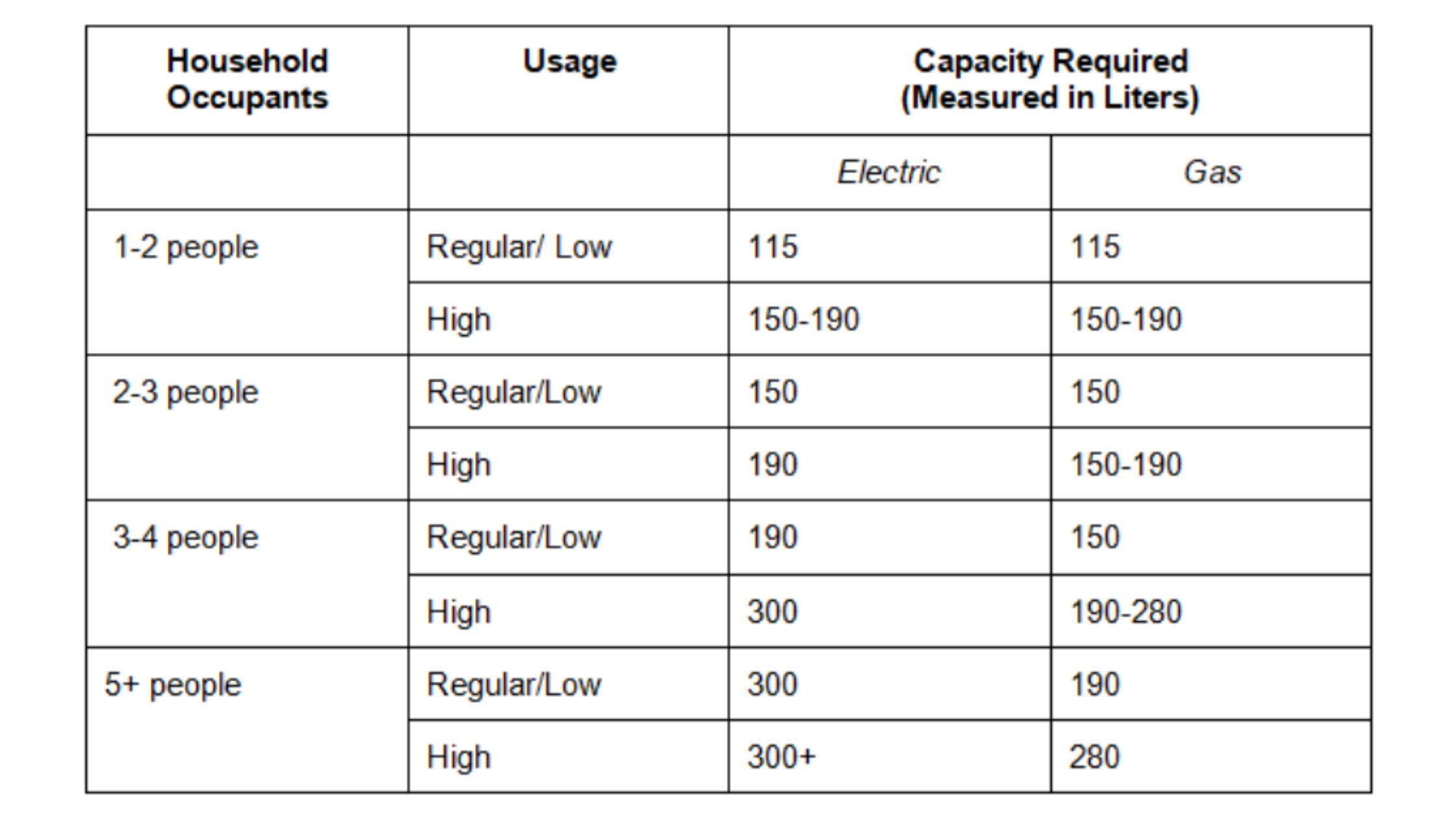
Tankless water heaters are much smaller than traditional units, and they are rated by the maximum temperatures possible at various flow rates. To determine the size your home will need, you’ll want to determine the number of devices the water will flow through, the flow rate of each device, and the temperature rise required. As an important note, do not focus on money savings by undersizing your tankless water heater, as it’s almost certainly going to lead to future frustration and issues. Before diving into the details, here is an easy-to-consume table that outlines the standard tankless water heater sizing requirements based on family size and usage:
With that in mind, let’s get started with the information you’ll need to select the right system for your home!
Determine the Maximum Number of Devices You Want to Run
To start with the tankless water heater sizing process, you’ll need to determine how many different devices the unit will be servicing. This will primarily include showers and faucets throughout the home, amongst other items. Once you have the devices accounted for, you’ll need to determine their flow rates – say, 2.8 liters per minute, per faucet, and 9.8 liters per minute, per shower – and add them up. With this capacity now determined, you’ll be able to calculate the hot water tank dimensions required. It’s important that water heater sizes meet all device requirements – at a minimum – with excess capacity being more than welcome should future renovations result in additional units.
Determine Required Temperature Rise
In order to determine the required temperature rise, you’ll need to subtract the incoming water temperature from the desired output temperature of the devices in your home. Unless you were given specific information from an authorized individual, assume that your incoming water temperature is approximately 10 degrees celsius. As a side, it’s best to approximate using a slightly lower incoming water temperature number to ensure that you don’t accidentally undersize your unit.
With the incoming water temperature now determined, you can complete the remainder of the calculation. Most homeowners will want water heated to a maximum of 40-45 degrees celsius, meaning that a tankless water heater with a temperature rise capacity of 35 degrees celsius or more is required.
Flow Rates
The next item of importance is to assess the tankless water heater flow rate. Put simply, this is the amount of water you’ll need at any given time – ensuring that you get a system large enough to meet household demand. Will you be running two showers at once? Do you often have multiple faucets in use at the same time? The chart below outlines standard household fixtures, alongside their average flow usage and temperature requirements:
FIXTURE | AVERAGE FLOW LPM | AVERAGE TEMP. |
Tub | 15 LPM | 39°C |
Shower | 9.5 – 11 LPM | 40°C |
Washing Machine | 7.5 LPM | 49°C |
Dishwasher | 5.5 LPM | 43°C |
Kitchen Sink | 5.5 LPM | 43°C |
With this, you can determine the total amount of flow required. If you often run two showers at once, or want to be sure that your water heater has the capacity to do so, you’ll need roughly 20 liters of hot water per minute from the tankless water heater. Regardless of the combination of fixtures, be sure that you’re sizing your tankless water heater in a way that allows your home to continually cycle hot water to all fixtures in use.
If you’re looking to have a new tankless hot water heater installed in your home, North Wind Heating and Air Conditioning has you covered. With years of experience in tankless water heater installation and maintenance, our expert team is well equipped to solve any problem at hand. To learn more about our services, or to request a free project estimate, contact us today!
✓ Expert Note — Our licensed Gas Technicians have installed and serviced hundreds of water heating systems across Ontario. The comparisons and cost figures below reflect current 2025 equipment pricing and Ontario contractor rates.
Frequently Asked Questions About Water Heaters in Ontario
How much does a tankless water heater cost in Ontario in 2025?
Tankless water heater installation in Ontario typically costs $2,500–$4,500 for a natural gas unit, installed. The unit itself costs $900–$2,200 depending on capacity (flow rate in GPM) and brand. Installation includes gas line work, venting, and water connections. Condensing tankless units (high-efficiency, 95%+ EF) cost more upfront but save $150–$300 annually compared to a standard storage tank. Navien, Rinnai, and Noritz are the most common brands we install.
How long does a tankless water heater last?
A well-maintained tankless water heater lasts 20–25 years – roughly twice as long as a traditional tank heater (8–12 years). Annual descaling (flushing with white vinegar or a descaling solution) is essential in Ontario, where hard water is common. Most manufacturers offer 10–15 year warranties on the heat exchanger when the unit is installed by a licensed technician and maintained according to schedule.
What size tankless water heater do I need for a typical Ontario home?
Sizing is based on peak flow demand (gallons per minute) and temperature rise needed. In Ontario, cold water entering the heater is typically 5–10°C. To raise it to 49°C (120°F), you need about a 39°C temperature rise. A family of 4 with 2 bathrooms typically needs a 9–10 GPM unit. Homes with multiple simultaneous hot water demands (shower + dishwasher + laundry) should size up. Our technicians do a proper sizing calculation before recommending a unit.
Is a tankless water heater better than a hot water tank?
Tankless units offer endless hot water, use 20–30% less energy, and last twice as long. They’re better for most households. However, tankless requires a higher gas flow rate (often 150,000–200,000 BTU/hr) – some homes need gas line upgrades to support this. They also have higher upfront costs and can’t supply large simultaneous demands without proper sizing. A storage tank is simpler and cheaper upfront but less efficient and has a shorter lifespan.
How often should I flush my hot water tank?
Ontario’s water is moderately hard in most regions, causing mineral buildup (scale) on heating elements and the tank bottom. Flush your hot water tank once per year by connecting a hose to the drain valve and letting it run until the water runs clear. This removes sediment that reduces efficiency and shortens tank life. For tankless units, a full descaling flush is recommended every 1–2 years depending on local water hardness.
What are signs my water heater needs to be replaced?
Key warning signs: the unit is over 10–12 years old (tank) or 20+ years (tankless), you notice rust-coloured water from hot taps, the tank is making popping or rumbling noises (sediment), the pilot light keeps going out, water is not getting as hot as it used to, or you notice water pooling around the base of the tank. A leaking tank cannot be repaired – it needs immediate replacement to prevent water damage.
Are there rebates for water heater installation in Ontario?
Enbridge Gas offers rebates for high-efficiency water heaters, including tankless condensing units (typically $150–$250). The Canada Greener Homes Grant includes water heating upgrades but requires an EnerGuide audit. Some municipalities and local utilities have their own programs. Always ask about current offers at the time of purchase – rebate programs change frequently and our team stays up to date.

Written by
David Tremblay
Heating & Ventilation Specialist | G2 Gas Technician (TSSA)
David Tremblay is a licensed heating and ventilation specialist with 12 years of field experience across Barrie, Collingwood, Muskoka, and surrounding Simcoe County communities. Holding a G2 Gas Technician licence from the TSSA and certification in commercial refrigeration, David focuses on water heating systems, indoor air quality, humidification, and whole-home ventilation. He is well-versed in Ontario Building Code requirements and helps homeowners understand seasonal HVAC maintenance and system optimization.
