 Proudly Canadian


 Home
Home Heating
 Cooling
 Heat Pumps
 Air Quality
 Other
OtherHVAC Tips and Tricks
What Is an HRV System and Does Your GTA Home Need One?
Mar
An HRV system, or Heat Recovery Ventilator, exchanges the stale air inside your home with fresh outdoor air while retaining most of the heat from the outgoing air. In the GTA, where newer homes are built airtight for energy efficiency, and winters are too cold to crack a window, an HRV system is often the only way to maintain healthy indoor air without wasting energy.
This guide covers what an HRV system actually does, who needs one, and what it realistically costs to install in a GTA home.
In this article
How an HRV system works
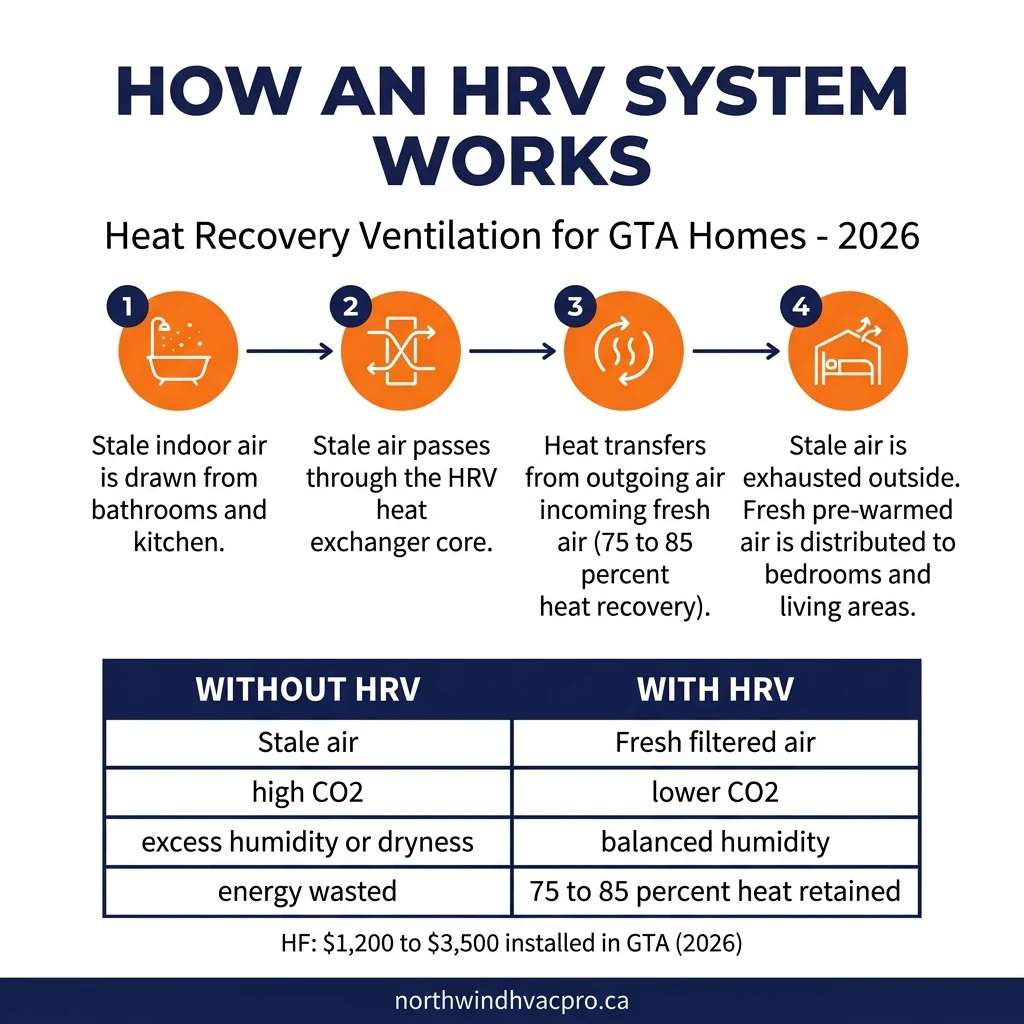
An HRV has two air streams that run through a central heat exchanger core, but never actually mix. One stream pulls stale indoor air out of the home, typically from bathrooms and the kitchen. The other pulls fresh outdoor air in. Inside the heat exchanger, the two streams pass close enough together that the warm outgoing air transfers its heat to the cool incoming air. By the time the fresh air enters your home, it has been pre-warmed using energy that would otherwise have gone straight outside.
Most HRV units on the market recover 70 to 85 percent of the heat from exhaust air. In a GTA winter where outdoor temperatures average minus 8 to minus 12 degrees Celsius, that heat recovery makes a meaningful difference in how much energy your furnace has to put in to maintain indoor comfort.
Did you know?
Without mechanical ventilation, CO2 levels in a bedroom overnight in a sealed home can reach 1,500 to 2,500 ppm. Health Canada recommends keeping indoor CO2 below 1,000 ppm for good cognitive function. An HRV running overnight keeps levels in the 600 to 800 ppm range typical of outdoor air.
HRV vs ERV: what’s the difference?
An ERV (Energy Recovery Ventilator) works the same way as an HRV but also transfers moisture between the two air streams, not just heat. This is the key distinction.
In Ontario’s climate, an HRV is almost always the right choice for residential use. Ontario winters are cold and dry. An HRV exhausts moisture along with stale air, which is what you want when you’re fighting excess indoor humidity from cooking, showering, and breathing. An ERV would retain that moisture, which can lead to condensation problems in tight Ontario homes.
ERVs are better suited for very dry climates where incoming outdoor air needs humidification to be comfortable. For Toronto, Vaughan, and the broader GTA, stick with an HRV unless you have a specific reason an HVAC engineer recommends otherwise.
Does your GTA home need an HRV?
Not every home in the GTA needs an HRV, but many do. The strongest candidates are homes built or significantly renovated after 1990, where improved insulation and sealing have reduced natural air infiltration to the point where the building no longer breathes adequately on its own.
Signs your home may need an HRV include persistent condensation on windows in winter, stuffy air that doesn’t seem to clear even with windows open briefly, elevated indoor CO2 readings (a $50 monitor reveals this quickly), chronic allergy or respiratory symptoms that improve noticeably when windows are open, and visible mould in bathrooms or near window frames despite regular cleaning.
Older drafty homes with natural air leakage through walls, windows, and foundations often don’t need an HRV because they already have adequate air exchange, though it’s happening without heat recovery if your home has been significantly air-sealed during a renovation, that changes the calculation.
People often ask: How do I know if my home needs an HRV?
The clearest signs are condensation on the inside of windows in winter, humidity above 50 percent indoors in January or February, and occupants feeling persistently tired or having headaches indoors that clear up when they go outside. A CO2 monitor placed in a bedroom overnight is a quick diagnostic tool. Readings consistently above 1,000 ppm indicate inadequate fresh air, which an HRV directly addresses.
Ontario building code and HRVs
The Ontario Building Code requires mechanical ventilation in new residential construction. Since 2012, all new homes in Ontario must have a principal air supply system that meets the ventilation requirements of the code, which in practice means an HRV or equivalent. If your home was built after 2012, it likely came with an HRV. If you bought an older home and the previous owner removed or didn’t install one, that’s worth addressing.
Adding an HRV to an existing home doesn’t require a permit in most Ontario municipalities as long as it’s connected to existing ductwork. Adding new ductwork may trigger a permit requirement depending on your municipality. NorthWind pulls appropriate permits as required for every installation.
HRV installation cost in the GTA (2026)
Pricing disclaimer: Ranges below are typical GTA market estimates for 2026. Actual cost depends on brand, system capacity, existing ductwork compatibility, and installation complexity. Homes requiring new ductwork runs will cost more. Get written quotes from at least two contractors. NorthWind does not guarantee any specific price.
| HRV tier | Typical installed cost (GTA) | Heat recovery |
|---|---|---|
| Entry-level unit (small home, basic controls) | $1,200 to $2,200 | 70 to 75% |
| Mid-range (most GTA homes, digital controls) | $2,000 to $3,000 | 75 to 82% |
| Premium (large home, zoned, high efficiency) | $2,800 to $3,500+ | 80 to 85% |
Cost drivers include home size (larger homes need a higher CFM unit), whether existing ductwork can be used or new runs are needed, and installation complexity in finished versus unfinished basements. The Heating, Refrigeration and Air Conditioning Institute of Canada (HRAI) provides guidance on sizing requirements for residential HRV installations.
How to know if your home needs an HRV
Please note: The diagnostic steps below involve visual inspection and basic monitoring only. Do not open your HRV unit or attempt to service it yourself. Annual HRV maintenance should be performed by a licensed HVAC technician. NorthWind Heating & Cooling is not liable for actions taken based on this content.
- Check your windows in January. Run your hand along the glass. Condensation or frost on the inside face of double-pane windows means indoor humidity is too high, a clear sign of inadequate air exchange.
- Measure indoor humidity. A $20 hygrometer from a hardware store shows your indoor relative humidity. Above 45 percent in January in a Toronto home means you are trapping too much moisture indoors.
- Put a CO2 monitor in your bedroom overnight. Check the reading in the morning. Above 1,000 ppm consistently means your home is not exchanging enough air while you sleep.
- Notice how you feel indoors versus outdoors. Persistent headaches, fatigue, or stuffiness that clears up quickly when you go outside is a textbook sign of poor ventilation.
- Check if you already have an HRV. Look for a box roughly the size of a small suitcase in your mechanical room with two sets of ducts attached. It may be labelled HRV or the brand name (Lifebreath, Venmar, Fantech are common).
Save your money
If you already have an HRV and it smells or isn’t working well, the fix is often just a filter cleaning, not a replacement. HRV filters clog with dust over time and reduce airflow significantly. Clean them every 3 months and have the core inspected annually. A dirty HRV running at reduced capacity barely helps with air quality and still uses the same electricity as a properly maintained unit.
Download the free quick guide
Save this checklist as a PDF and keep it handy for your next HVAC decision.
Frequently asked questions
Do I need an HRV if I have a newer home in the GTA?
If your home was built after 2012 in Ontario, it should have come with a mechanical ventilation system meeting the Ontario Building Code requirements. Many newer GTA homes include an HRV as standard equipment. Check your mechanical room. If you find one, make sure it’s operating correctly and the filters are clean. If there isn’t one and your home is well-sealed, it may be worth having an assessment.
Will an HRV make my home feel drafty in winter?
A properly sized and installed HRV should not create noticeable drafts. The incoming air is pre-warmed before it enters the living space. Some people feel a slight temperature difference near supply registers in very cold weather, particularly if the unit is oversized or the airflow is unbalanced. A technician can balance the airflows if this becomes an issue.
What maintenance does an HRV need?
HRV filters should be cleaned every 3 months during heavy-use seasons. The heat exchanger core needs annual cleaning to remove dust and maintain efficiency. The drain at the bottom of the unit should be checked annually to ensure it’s not blocked. Most homeowners can handle filter cleaning themselves; core cleaning is best left to a technician.
How long does an HRV last?
A well-maintained HRV typically lasts 15 to 20 years. The motor is the most common component to fail, and it can often be replaced without replacing the entire unit. Neglected HRVs with dirty cores and clogged filters burn out motors faster due to the added strain.
HRV installation and service in the GTA
NorthWind installs and services HRV systems across Toronto, Markham, Richmond Hill, Oakville, and surrounding areas. Free in-home estimates include airflow assessment and sizing recommendation.

Written by
Lisa Santarossa
Building Science Specialist | Ontario Home Inspector (OAHI)
Lisa Santarossa is an Ontario-certified home inspector and building science specialist who has assessed over 2,000 residential properties across the GTA, focusing on ventilation, moisture control, and HVAC condition.
