 Proudly Canadian


 Home
Home Cooling
 Heating
 Heat Pumps
 Air Quality
 Other
Other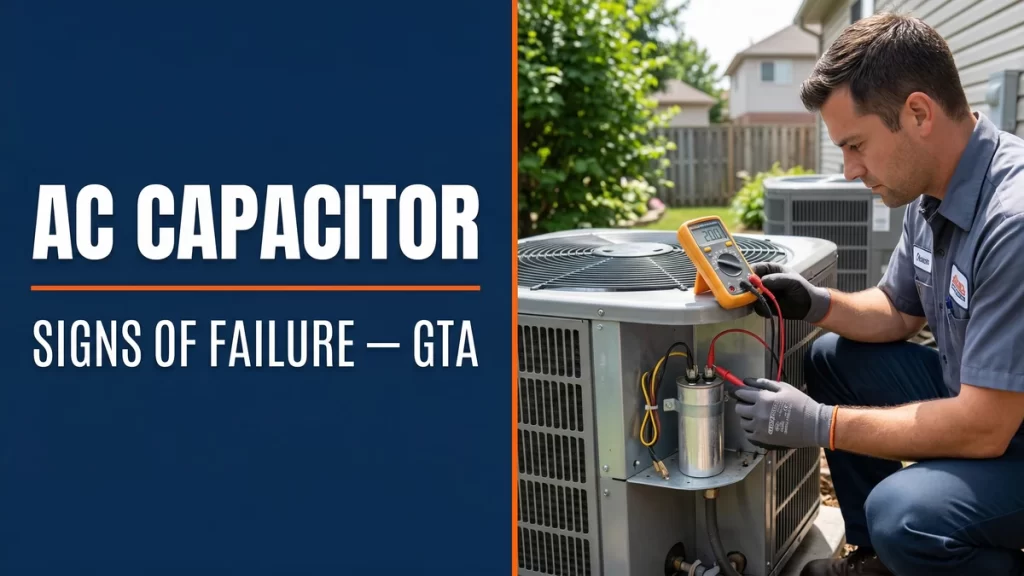
A failing AC capacitor is responsible for more service calls in the GTA than almost any other single component, and the warning signs are hard to miss once you know what to look for. Capacitor failure is the single most common AC repair we see in the GTA, especially on systems that are eight years old or older. A capacitor is a small cylindrical component that stores and releases electrical energy to start and run the compressor and fan motors. When it degrades, the system can still appear to run but produces significantly less cooling, or fails to start certain components entirely.
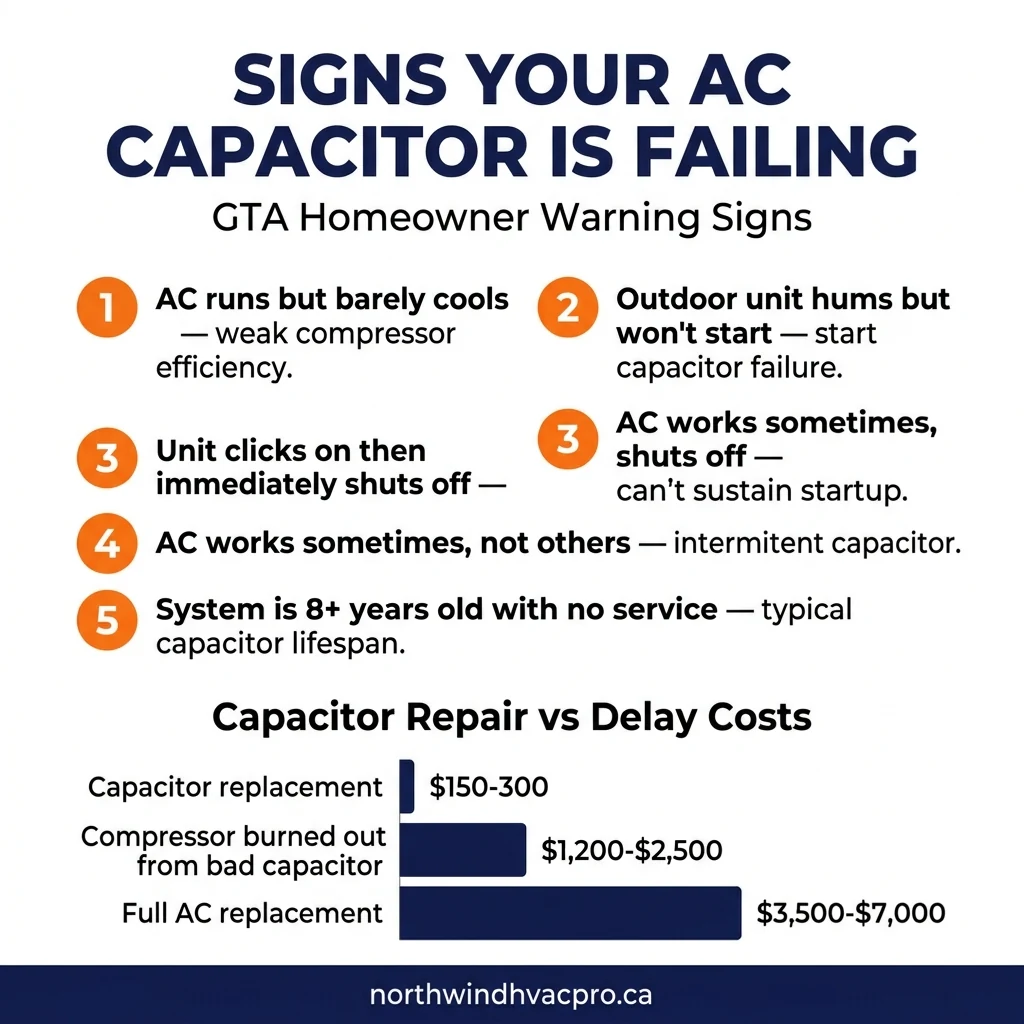
The good news: it is one of the cheaper AC repairs. A capacitor replacement is typically $150 to $300 in the GTA, takes under an hour, and resolves the problem completely if that was the only issue. The bad news: if you ignore a failing capacitor and keep running the system, you can burn out the compressor, which is the most expensive component in the unit.
In this article
What a capacitor does in an AC system
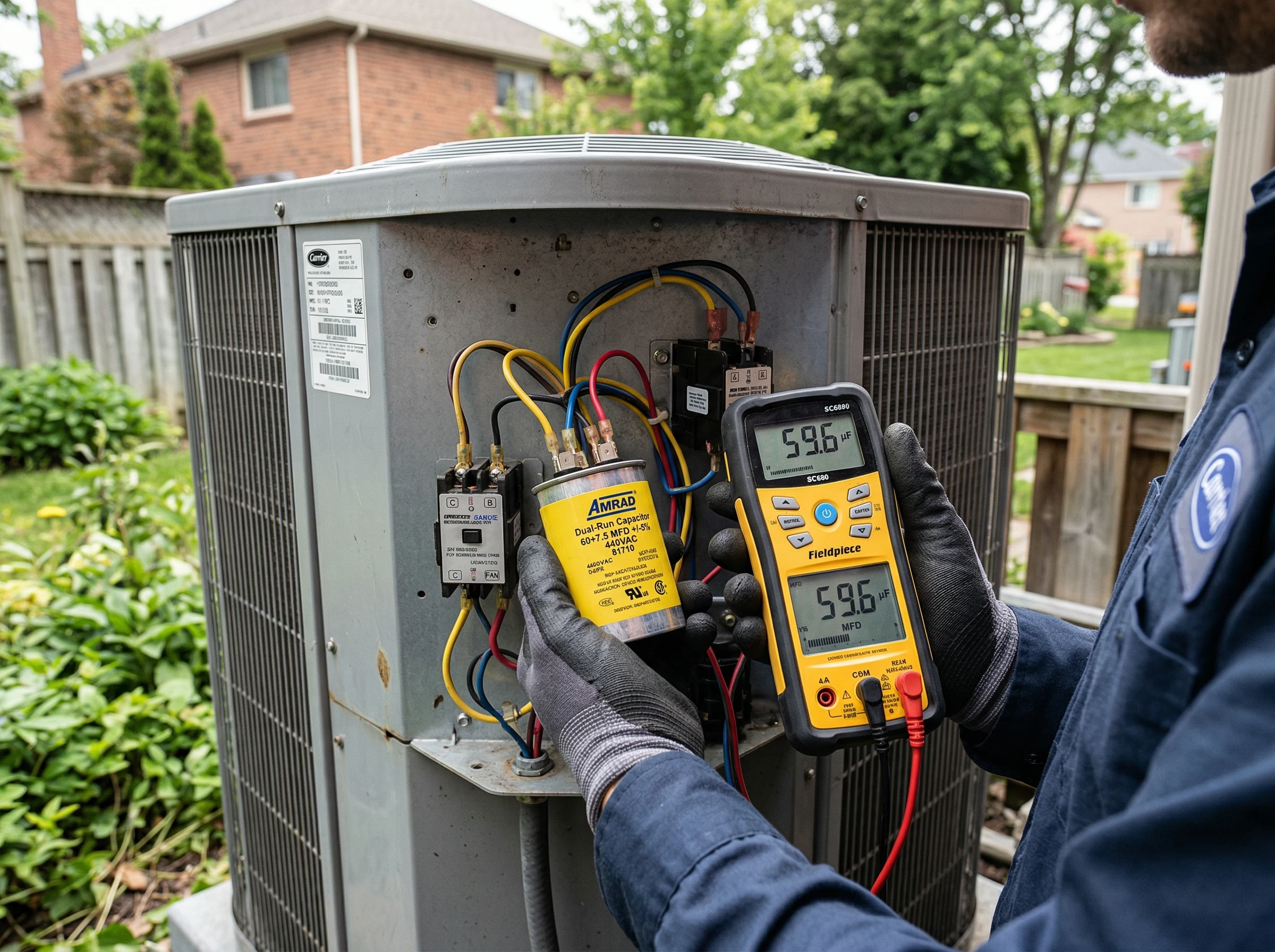
An AC system has two main capacitors: the start capacitor and the run capacitor, though many modern units use a single dual-run capacitor tha t handles both functions. The start capacitor provides the extra electrical boost the compressor motor needs to start turning. The run capacitor keeps the compressor and condenser fan motor running efficiently during normal operation.
Without a functioning run capacitor, the motor draws more amperage to do the same work, which generates heat and accelerates wear. Without a start capacitor, the motor cannot start at all. Either failure shows up as symptoms that are easy to mistake for other problems.
Signs your capacitor is degrading
The AC runs but barely cools
A weak run capacitor causes the compressor to run less efficiently. The system appears to be working — you can hear it running, the fan is spinning — but the air coming from the vents is not cold enough, or it takes much longer than usual to cool the house down. This is one of the most common presentations of a failing capacitor and is frequently misdiagnosed as a refrigerant issue.
The outdoor unit hums but does not start
If you can hear the outdoor unit humming when the thermostat calls for cooling but the fan is not spinning and the compressor is not running, a failed start capacitor is the most likely cause. The motor is trying to start but cannot generate enough torque. You might hear a brief humming followed by a click as the safety protection trips.
The system works fine for a few minutes then shuts off
A capacitor that is marginal but not completely failed may allow the system to start, but as the capacitor heats up during operation it degrades further, causing the motor to draw excessive amperage and trip the overload protection. The system runs for 5 to 15 minutes, shuts off, sits for a while, then starts again. This can go on all summer before the capacitor fails completely.
What happens if you keep running it
Running the system with a failing capacitor is hard on the compressor. The compressor motor is drawing more current than it should on every cycle, which generates heat inside the motor windings. Over time, that overheating burns out the motor insulation and eventually causes a compressor winding failure.
A capacitor replacement is $150 to $300. A compressor replacement is $800 to $2,000. If a technician identifies a weak capacitor on a service call and recommends replacement, take it seriously even if the system is technically still working. It is almost always cheaper to replace the capacitor than to find out later that running it killed the compressor.
How technicians test capacitors
Capacitor health is tested with a multimeter measuring capacitance in microfarads (uF). Every capacitor has a rated capacitance printed on it, typically something like 45/5 uF for a dual-run capacitor (45 uF for the compressor, 5 uF for the fan). A reading within 6 percent of the rated value is generally considered acceptable. Below that, the capacitor is marginal and should be replaced proactively. If you see the technician test the capacitor during a tune-up and recommend replacement even though the system is still running, that is usually sound advice.
Capacitor replacement costs in the GTA
Capacitor replacement including parts and labour typically runs $150 to $300 depending on the capacitor type and size. Some high-capacity capacitors for larger systems cost more. On an emergency call in the middle of summer, expect to pay the diagnostic fee plus the repair, which brings the total to $250 to $400 all in.
If your capacitor has failed more than once in a few years on the same unit, that can be a sign of an underlying electrical issue (voltage fluctuations, loose connections) rather than just normal wear. Ask the technician to check the voltage supply to the outdoor unit when replacing a repeat-failure capacitor.
Service areas for AC repair
- Vaughan
- Mississauga
- Brampton
- Markham
- Richmond Hill
- Scarborough
- Etobicoke
- Aurora and Newmarket
- Oakville and Burlington
- Ajax, Pickering, and Whitby
Book ac repair in the GTA
NorthWind offers same-week service across the GTA. Free estimates on all ac repair service calls.

Written by
Oleksii Sitalo
Oleksii Sitalo is an HVAC professional with hands-on experience in heating, cooling, air conditioning, furnace systems, and home comfort solutions.
