 Proudly Canadian


 Home
Home Heating
 Cooling
 Heat Pumps
 Air Quality
 Other
OtherHVAC Tips and Tricks
Why Your Furnace Keeps Turning On and Off (Short-Cycling Causes and Fixes)
Mar
This article is also available as a podcast. Hit play to listen while you work or commute. Audio is also useful if reading on a screen is difficult — this player is fully compatible with screen readers and assistive technology.
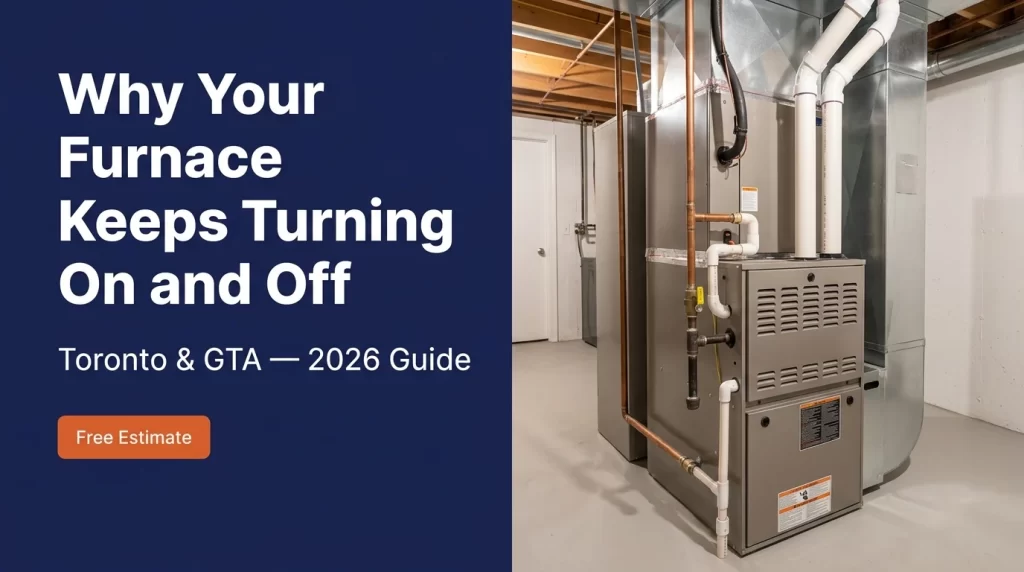
When a furnace keeps turning on and off every few minutes, running briefly before shutting down again, it’s called short-cycling. It’s one of the more common heating problems in GTA homes, and it gets worse over time if it isn’t dealt with. The good news is that most of the causes are fixable, and some of them you can check yourself before calling anyone.
This post covers what short-cycling actually is, why it matters, the seven most common causes, what you can check yourself, and what repairs cost in the GTA right now. If you already know you need a technician, you can go straight to furnace repair service or get a free estimate.
People often ask: why does my furnace turn on and off every few minutes?
Short-cycling is usually caused by one of a handful of fixable problems: a clogged air filter, an oversized furnace, a tripping limit switch, or a fouled flame sensor. The fix depends on the cause, but a diagnostic visit will identify it. Most short-cycling repairs run $100 to $400 in the GTA.
In this article
- Why your furnace keeps turning on and off
- Why short-cycling is a problem
- 7 common causes of furnace short-cycling
- What to check yourself before calling a technician
- When to call for professional furnace repair
- Furnace short-cycling repair costs in the GTA (2026)
- How to prevent short-cycling
- Normal cycling vs short-cycling
- Furnace service across the GTA
- Frequently asked questions
Why your furnace keeps turning on and off
Short-cycling is when a furnace starts a heating cycle, runs for a brief time, shuts down before the thermostat is satisfied, and then starts up again shortly after. A normal heating cycle runs roughly 10 to 15 minutes. The furnace fires up, heats the air, the blower circulates it through the house, and the thermostat eventually registers that the target temperature has been reached. Then it shuts down and stays off for a while.
Short-cycling interrupts that process. Instead of completing a full cycle, the furnace runs for 2 to 5 minutes, stops, and restarts repeatedly. Some homeowners notice it right away because the furnace sounds like it’s running constantly without actually warming the house. Others notice it only when the gas bill comes in higher than expected, or when a technician points it out during a service call.
Why short-cycling is a problem
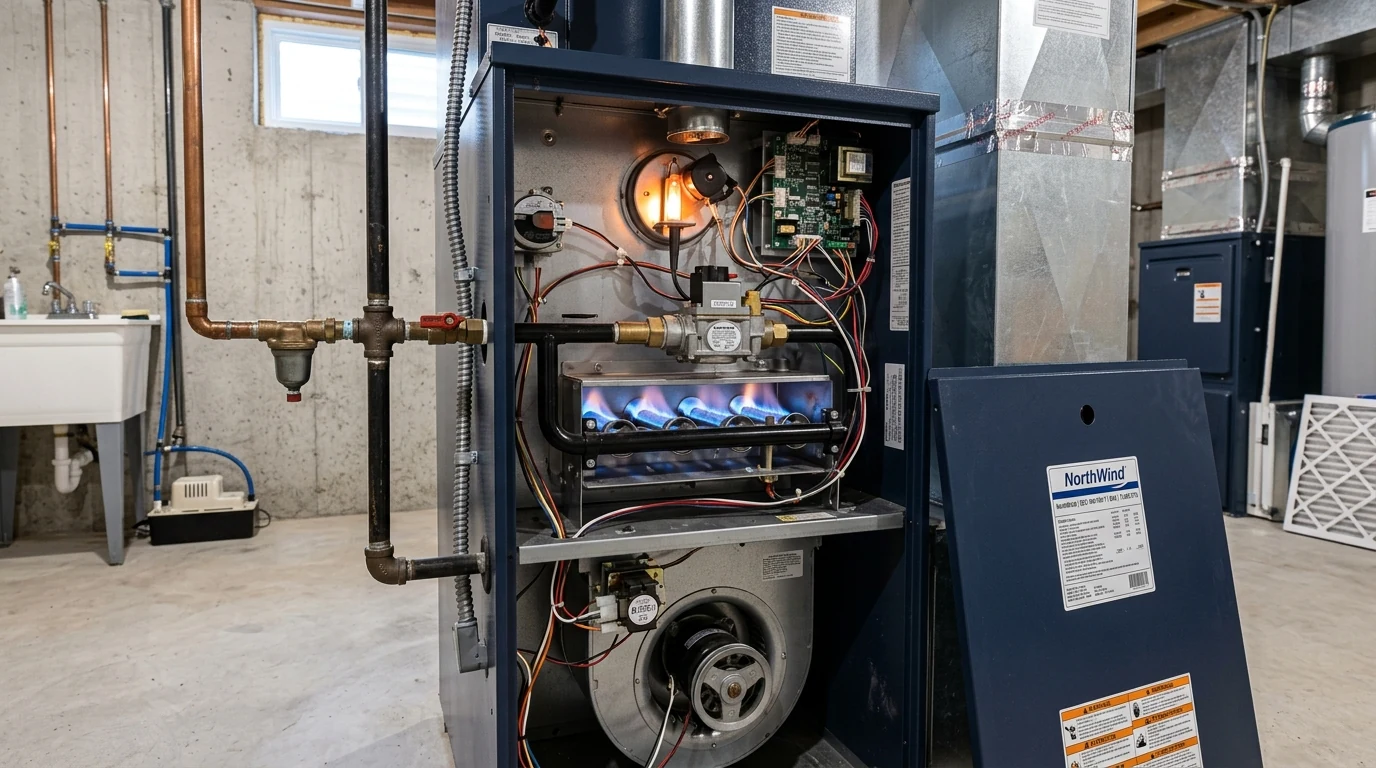
Every time a furnace starts up, the igniter fires, the gas valve opens, the burners light, and all the mechanical components go through a startup sequence. That’s the most stressful part of the cycle. Short-cycling means the system goes through that sequence many more times per hour than it’s designed for, and that accelerates wear on virtually every component involved.
The heat exchanger is particularly vulnerable. It expands as it heats up and contracts as it cools, and that thermal stress is manageable over a normal number of cycles per day. When the cycle count doubles or triples because of short-cycling, the metal fatigues faster. Cracks in the heat exchanger are one of the more serious furnace problems because they can allow combustion gases, including carbon monoxide, to enter the air supply. It’s a safety issue, not just a repair bill.
Short-cycling also makes the system inefficient. A furnace that runs 8 full cycles per hour burns gas throughout each cycle. A furnace that short-cycles might start 20 or 25 times in the same hour, and each startup burns a small amount of gas just to ignite and bring the heat exchanger up to temperature. That overhead adds up and raises your gas bill without actually heating the house any better. If anything, a short-cycling furnace often struggles to maintain the set temperature because it never completes a full cycle.
Did you know?
An oversized furnace is one of the most common causes of short-cycling, but it’s also the hardest to fix without replacing the unit. Contractors size furnaces using heat load calculations. A furnace that’s too large heats the space too fast, satisfies the thermostat quickly, and shuts off before the full cycle completes. This leaves cold spots, high humidity, and dramatically shorter system life. Always get a proper Manual J load calculation before buying a new furnace.
7 common causes of furnace short-cycling
1. Oversized furnace
An oversized furnace heats the space too quickly. The thermostat reaches the set temperature before the full heating cycle completes, so it shuts the furnace off early. Then the house cools again, and the cycle restarts. On paper this sounds like efficiency, but in practice it means the house has temperature swings, the furnace runs through more startups per day than a properly sized unit would, and the humidity distribution is uneven because the air isn’t circulating long enough per cycle.
Oversizing is surprisingly common in the GTA. Contractors sometimes size furnaces conservatively, meaning larger, to avoid callbacks from homeowners who say the house isn’t warm enough. The result is a unit that’s too powerful for the actual heat load of the home. The only real fix is replacing the furnace with a correctly sized unit, which requires a proper Manual J heat load calculation before installation.
If your furnace was recently replaced and short-cycling started shortly after the new installation, ask your contractor to confirm the sizing calculation. A furnace that’s one size too large for the home is a common and avoidable mistake. If you’re looking at a new furnace installation, make sure the company you hire performs a proper load calculation rather than just matching the output of your old unit.
2. Dirty air filter
A clogged air filter restricts the airflow going through the system. Without enough air moving across the heat exchanger, the exchanger overheats. Modern furnaces have a high-limit safety switch that shuts the system down when the internal temperature gets too high. The furnace stops, cools down a bit, then tries to start again. The same overheating happens again, and the cycle repeats.
This is the most common cause of short-cycling that homeowners can fix themselves. Pull the filter out and look at it. If it’s grey and visibly matted, replace it. One-inch fiberglass filters should be replaced monthly during heavy use. Thicker pleated filters can last 2 to 3 months. Once you have a clean filter installed, give the system 15 to 20 minutes to cool down if it was overheating, then restart it and see if the cycling pattern returns to normal.
Filters are cheap, usually $5 to $20, and replacing them on a regular schedule prevents a long list of problems beyond just short-cycling. Set a reminder in your phone for every 6 to 8 weeks during the heating season. It takes 2 minutes and it’s one of the highest-value maintenance habits you can build around your furnace.
3. Overheating heat exchanger
If the air filter is clean but the furnace is still shutting down early, the high-limit switch may be tripping because the heat exchanger itself is running too hot. This can happen even with decent airflow if the heat exchanger has a blockage, a partial crack, or if the system has been running with restricted airflow for long enough that the exchanger is in a degraded state.
A high-limit switch that trips repeatedly will sometimes fail in the closed position, meaning the furnace won’t run at all until the switch is replaced. But more often the switch works correctly and is simply responding to a real overheating problem. A technician can measure the temperature rise across the heat exchanger to determine if it’s within the manufacturer’s specified range, and inspect the exchanger visually and with a camera probe for signs of damage.
A cracked heat exchanger is one of those diagnoses that makes the repair vs replace question urgent. Repair usually means exchanger replacement, which on older furnaces often costs more than the remaining value of the unit. If your furnace is 12 years old or older and has a cracked exchanger, replacement of the whole system is almost always the right call.
4. Thermostat problems
A thermostat that’s reading the room temperature inaccurately will send incorrect signals to the furnace. If it thinks the room is already at the set temperature when it isn’t, or if it has a temperature sensor that’s drifting, the furnace may shut off prematurely. If the thermostat is mounted near a heat source like a lamp, a vent, or a west-facing window that gets afternoon sun, it can read the ambient temperature around itself rather than the true room temperature.
Wiring issues can also cause erratic behavior. Loose connections at the thermostat terminals, or at the furnace control board, can cause intermittent signals that look like short-cycling from the outside. A quick check is to look at the wiring connections at both ends and confirm nothing is loose or corroded.
Smart thermostats can also cause this problem when they’re misconfigured. The minimum cycle duration setting, sometimes called “minimum on time,” controls how long the furnace runs before the thermostat allows it to shut off. If that setting is too short, the thermostat may cut the cycle off before the home has warmed up. Check your thermostat’s settings menu if it’s a programmable or smart model.
5. Flue or exhaust blockage
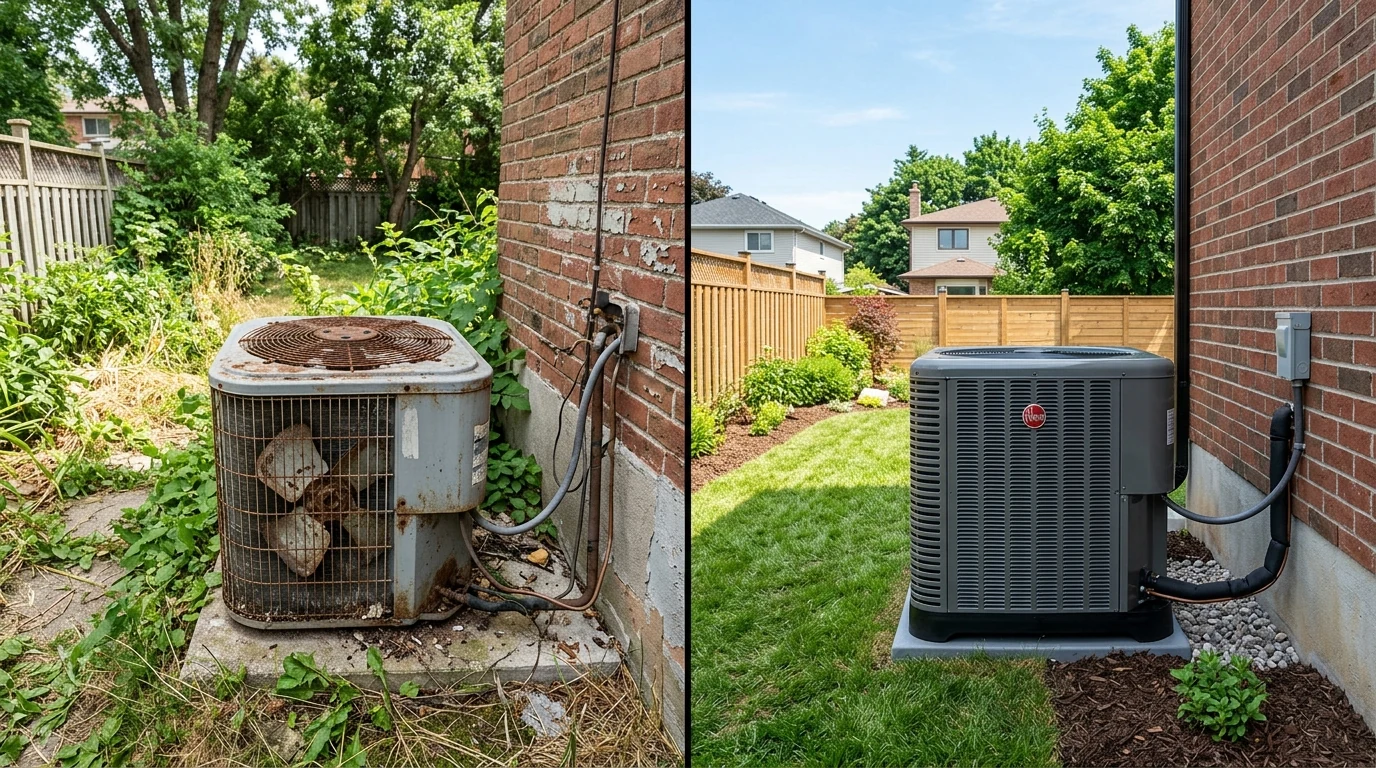
High-efficiency furnaces vent through PVC pipes that exit through the side of the house, usually near the foundation. Those vent pipes can get partially or fully blocked, especially in winter. Snow and ice can cover the exhaust or intake opening. Bird nests, wasps’ nests, or debris can build up in warmer months. When the flue is blocked, combustion gases can’t exit properly and the furnace shuts down on its pressure switch or flame sensor.
Older furnaces with metal flue pipes going through the roof have a different set of issues: the pipe can develop a blockage from debris, the cap can come loose or corrode, or in cold weather, condensate can freeze and partially block the flow. Either way, a blocked flue is something to take seriously because it can result in incomplete combustion and carbon monoxide buildup if the safety systems don’t catch it.
This is one of the checks you can do yourself: go outside and locate the exhaust and intake pipes. Make sure they’re clear of snow, ice, and debris. If the opening is blocked, clear it carefully and see if the furnace runs normally afterward. If you can see into the pipe and spot a blockage further in, that needs a technician to clear properly.
6. Flame sensor failure
The flame sensor is a small metal rod that sits in the burner flame and confirms to the control board that ignition was successful. If the control board doesn’t detect a signal from the flame sensor within a few seconds of ignition, it shuts off the gas as a safety measure and tries again. If it fails to confirm combustion after 2 or 3 attempts, it locks out and stops trying.
Flame sensors fail in two ways. The more common failure is simply a buildup of oxidation on the sensor rod, which reduces its ability to conduct the microampere current that tells the control board a flame is present. A technician can clean the sensor with fine steel wool or emery cloth in about 20 minutes, and that’s often enough to restore normal function. The part itself costs a few dollars, and the labour is about an hour’s time.
If the sensor is cracked or has completely failed, it needs to be replaced. Flame sensor replacement is usually $150 to $300 including the service call. It’s one of the simpler furnace repairs, and a clean or new flame sensor is also something that gets done as part of a proper annual furnace tune-up, which is one of the reasons regular maintenance catches these problems before they cause a breakdown.
7. Low gas pressure
If the gas pressure at the furnace is lower than the burners require, ignition may be weak or inconsistent, and the flame sensor may not detect a stable enough flame to keep the system running. The control board shuts down, waits, tries again. This shows up as short-cycling or as repeated ignition attempts with the burners lighting briefly before shutting off.
Low gas pressure can come from a problem at the gas regulator on the furnace, a partially closed gas valve, an issue with the gas line itself, or in some cases a supply pressure problem from the utility. If multiple gas appliances in the home are behaving oddly at the same time, for example a gas range with low flames and a furnace that won’t stay lit, suspect a supply or regulator issue rather than something specific to the furnace.
Gas pressure checks require a manometer and knowledge of the furnace’s specified operating pressure, which varies by model. This is not a DIY check. A technician can measure the manifold pressure at the gas valve and compare it to the manufacturer’s spec within a few minutes. If the pressure is off, they can adjust the gas valve or identify where the pressure loss is occurring.
What to check yourself before calling a technician
Before you pick up the phone, go through these four checks. They’re quick, they cost nothing, and one of them might solve the problem entirely.
Step 1: Replace the air filter
Pull the filter out and look at it. If it’s dark and visibly restricted, it’s the most likely cause of what you’re seeing. Replace it with a clean filter of the same size and MERV rating, then wait 15 to 20 minutes and watch whether the furnace completes a normal cycle. If it does, you’ve found the problem. Going forward, check the filter monthly during the heating season and replace it before it gets that clogged again.
Step 2: Check the thermostat
Make sure the thermostat is in heating mode, not cooling or fan-only. Set the temperature 3 to 5 degrees above the current room reading to make sure the furnace actually gets a call for heat. If you have a smart thermostat, check whether any schedules or eco modes might be cutting cycles short. Replace the batteries if the display seems dim or inconsistent. If you changed the thermostat recently and short-cycling started around the same time, that’s worth noting when you talk to a technician.
Step 3: Look at the vents and return air grilles
Walk through the house and make sure the supply vents are open and not blocked by furniture, rugs, or stored items. Also check the return air grilles, the larger grilles that pull air back toward the furnace. A blocked return reduces airflow through the system just as effectively as a clogged filter and causes the same overheating response.
Closing off vents in unused rooms is a common habit that actually causes more problems than it solves. The furnace is designed to push air through a certain resistance (the full duct system), and closing vents increases that resistance. The result is reduced airflow, which causes overheating, short-cycling, and in some cases duct leaks from the elevated pressure.
Step 4: Check the exhaust flue outside
For high-efficiency furnaces, find the PVC vent pipes on the exterior of the house, usually on the side or the back near the foundation. Make sure they’re not covered in snow or ice, and that nothing is blocking the opening. For older furnaces with a metal flue through the roof, have a look up at the cap if you can see it safely from the ground. A clearly visible blockage can sometimes be cleared without a service call, but if the pipe itself has an issue, that needs a technician.
When to call for professional furnace repair
If you’ve gone through the checks above and the furnace is still short-cycling, book a service call. The remaining causes, flame sensor failure, heat exchanger problems, gas pressure issues, cracked components, are not things a homeowner can safely diagnose or fix without proper tools and training. Running a furnace that’s shutting down on a safety limit repeatedly is not safe to ignore. Those limits exist because something is actually wrong.
Call immediately if you smell gas near the furnace, if your carbon monoxide detector goes off, if you see soot or black residue around the burner compartment, or if the furnace won’t run at all after going through several restart attempts. These are not situations to troubleshoot yourself. Gas appliances that fail in ways that involve combustion or venting are a fire and CO risk, and they need a licensed gas technician. You can reach NorthWind for furnace repair across the GTA any time.
Short-cycling that has been going on for weeks or months should also be treated as urgent, even if the furnace seems to be “sort of working.” The accelerated wear on the heat exchanger described earlier is happening the whole time, and a small problem is quietly becoming a larger and more expensive one every day it goes unaddressed.
Ontario licensing requirement
In Ontario, all gas appliance work must be performed by a TSSA-licensed G1 or G2 gas technician. This is a legal requirement under the Technical Standards and Safety Act, 2000, S.O. 2000, c. 16. You can verify a technician’s licence at tssa.org. NorthWind Heating & Cooling does not recommend DIY work on gas appliances. All information in this post is for general educational purposes only.
Emergency contacts
- Gas leak or gas smell: Leave immediately, do not use switches or phones inside. Call Enbridge Gas emergency line: 1-866-763-5427 (24/7), then 911.
- Carbon monoxide alarm: Leave the building, get fresh air, call 911.
- TSSA gas safety incidents: tssa.org/en/fuels/report-an-incident.aspx
If your furnace problem involves a gas smell, a CO alarm, or soot around the burner compartment, evacuate and call emergency services first. Do not attempt to troubleshoot a possible gas leak yourself.
Furnace short-cycling repair costs in the GTA (2026)
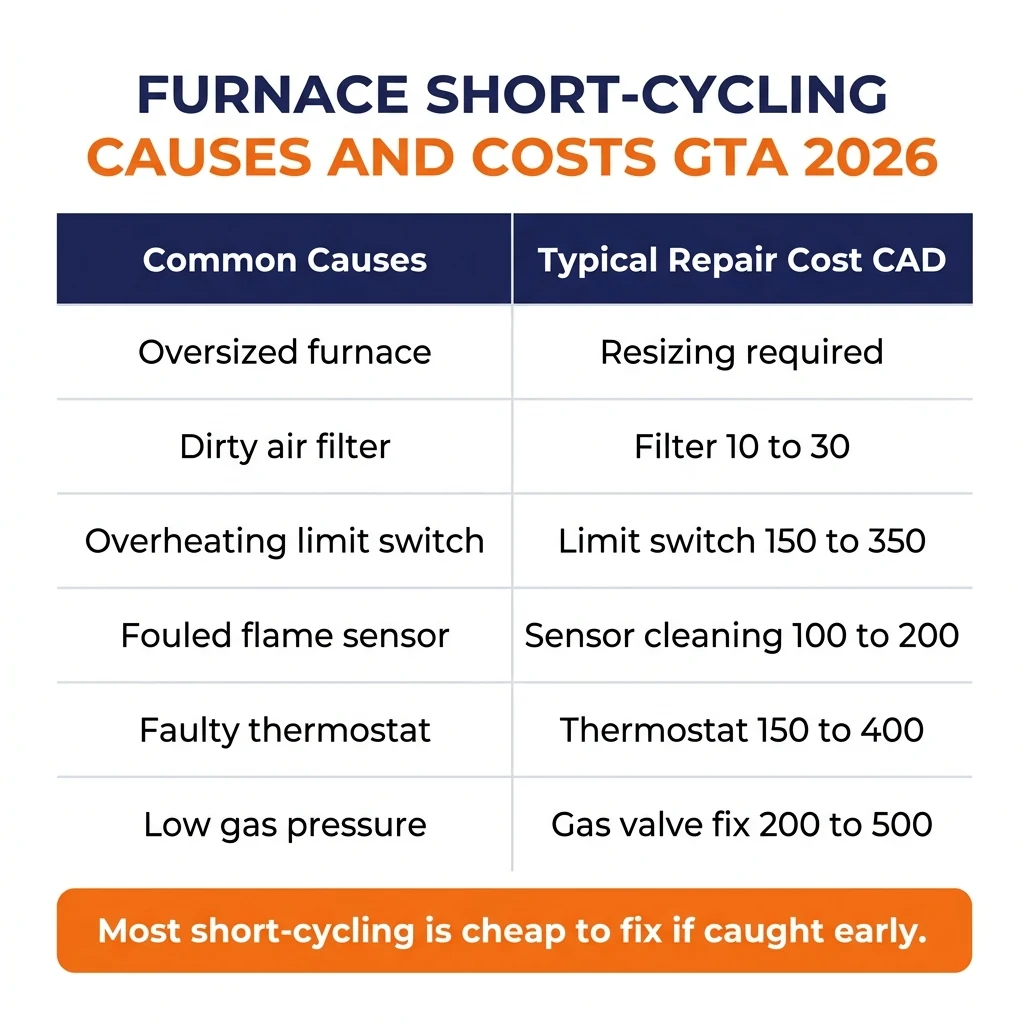
Short-cycling repair costs vary a lot depending on the root cause. Here are realistic ranges for the most common repairs in the Toronto and GTA market.
Pricing note: The cost ranges below are estimates based on typical GTA market rates as of 2026. Actual quotes will vary based on your specific system, the brand and availability of parts, home accessibility, labour rates in your area, and whether the work is performed during regular hours or as an emergency call. Request a written quote before authorizing any work.
| Repair type | Estimated cost (GTA, 2026) |
|---|---|
| Air filter replacement (homeowner) | $5 to $20 |
| Flame sensor cleaning | $100 to $200 |
| Flame sensor replacement | $150 to $300 |
| High-limit switch replacement | $150 to $350 |
| Thermostat replacement | $200 to $500 installed |
| Flue cleaning or blockage removal | $150 to $300 |
| Gas valve or pressure adjustment | $200 to $450 |
| Heat exchanger replacement | $800 to $1,800 |
Diagnostic fees in the GTA typically run $80 to $120. Most companies apply that fee toward the repair if you proceed, so ask about this upfront. If a technician quotes a heat exchanger replacement on a furnace that’s 12 or more years old, it’s worth getting a second opinion and a quote on full furnace replacement at the same time before committing. In many cases the numbers favour replacement, especially if a higher-efficiency model would reduce your gas bills meaningfully.
Save your money
A dirty air filter is the cheapest possible cause of short-cycling. A replacement filter costs $10 to $30 and takes 5 minutes to swap out. If your furnace is cycling every few minutes, check the filter first before calling anyone. If that’s the culprit, you’ve just saved yourself a $100 diagnostic fee. Check and replace filters every 1 to 3 months during heating season.
Is it worth repairing my short-cycling furnace?
Rough guide only. A licensed technician who has inspected the unit gives a more reliable assessment. Book a free estimate.
How to prevent short-cycling
Most of the causes of short-cycling are either preventable or catchable early with basic maintenance. The most effective habit is annual furnace service in the fall before the heating season starts. A technician will clean the flame sensor, check the heat exchanger, verify gas pressure, test the safety switches, inspect the flue, and replace any components that are showing wear. That single service appointment addresses most of the items on the short-cycling causes list before they become problems.
Filter changes are the other big one. Monthly checks during heavy use, replacement every 1 to 3 months depending on the filter type and household, and never letting a filter run until it’s visibly plugged. These two habits alone prevent a significant share of the service calls we see in the GTA every winter.
Proper airflow through the whole system matters too. Keep vents unobstructed, don’t close off rooms with supply vents, and make sure the return air grilles are clear. If your house regularly feels uneven in terms of heating, with some rooms too warm and others not warm enough, that’s worth having a technician assess. It might be a duct balancing issue, an undersized return, or a zoning problem, but uneven airflow also puts stress on the furnace over time. Ask about NorthWind’s maintenance plans if you want annual service handled automatically rather than having to remember to book each fall.
Normal cycling vs short-cycling
What a normal furnace cycle looks like
A normal furnace cycle starts when the thermostat calls for heat. The inducer fan runs for about 30 seconds first, purging the heat exchanger before ignition. Then the igniter heats up, the gas valve opens, the burners light, and the main blower fan starts moving air a minute or so later once the heat exchanger is up to temperature. The system runs steadily, the house warms, and when the thermostat is satisfied, everything shuts down in reverse order. The whole cycle takes 10 to 15 minutes, sometimes longer on very cold days.
Between cycles, the furnace stays off for 5 to 10 minutes or more, depending on how well-insulated the house is and how cold it is outside. In mild weather, cycles may be further apart and shorter. On a -20C night, they may be longer and more frequent. All of that is normal. What you’re listening for is whether each cycle that does run actually completes.
Signs it has crossed into short-cycling
Short-cycling is reasonably easy to recognize once you know what to listen for. The furnace starts, the blower runs for a minute or two, then everything shuts off. A few minutes later it starts again. The house either isn’t reaching the set temperature or it takes much longer than it used to. You might also hear the igniter clicking repeatedly as the furnace tries and fails to complete a cycle before shutting down.
A useful test: watch the thermostat display while the furnace runs. If the actual temperature reading barely moves before the furnace shuts off, it short-cycled. If the temperature reaches the set point and the furnace shuts off normally, that particular cycle was fine. Short-cycling usually shows up consistently across multiple cycles, not just once in a while.
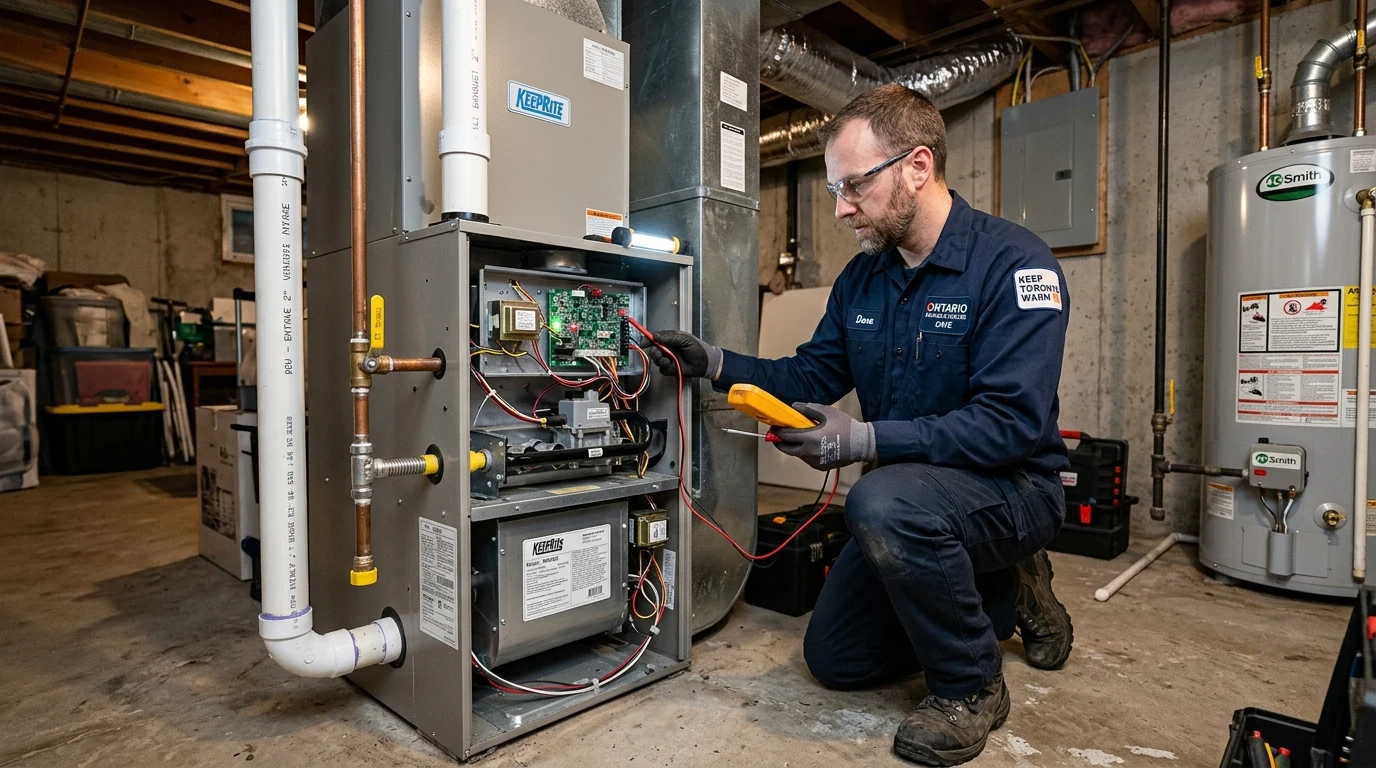
Pro tip
Before calling for a diagnosis, run your furnace through one full cycle and time it. A healthy furnace runs 10 to 15 minutes per cycle in cold weather. Write down how long it runs and how long between cycles. Share this with the technician when you call. That context helps them narrow the cause faster and can reduce the time they spend diagnosing on-site.
Furnace service across the GTA
NorthWind provides furnace repair and maintenance across the Greater Toronto Area. Service areas include:
- Vaughan
- Mississauga
- Brampton
- Markham
- Richmond Hill
- Scarborough
- Etobicoke
- Aurora and Newmarket
- Oakville and Burlington
- Ajax, Pickering, and Whitby
If your furnace has been short-cycling and you’re not sure whether repair or replacement makes more sense, our technicians can give you an honest assessment of the unit’s condition and what it’s likely to need going forward. For homeowners considering switching to a heat pump instead of replacing a furnace, see our breakdown of current heat pump grants available in Ontario. Book a free estimate online or call us directly.
Frequently asked questions
How many times per hour should a furnace cycle?
A properly sized furnace in a typical GTA home runs 3 to 8 cycles per hour depending on outdoor temperature, home insulation, and thermostat settings. On a very cold night it might cycle more frequently and run longer each time. On a mild day it might run once or twice an hour. If you’re counting more than 8 to 10 startups per hour, something is causing the cycles to cut short before the thermostat is satisfied.
Is furnace short-cycling dangerous?
It depends on the cause. Short-cycling from a dirty filter or an oversized furnace is more of a mechanical and efficiency problem than an immediate safety risk. Short-cycling caused by a cracked heat exchanger or a flue problem is a different story. If combustion gases including carbon monoxide are not being properly vented because the furnace keeps shutting down on a pressure switch, that becomes a safety issue. Make sure your home has working carbon monoxide detectors, especially near sleeping areas, and book a service call promptly rather than assuming the issue is minor.
Can I fix short-cycling myself?
You can fix it yourself if the cause turns out to be a dirty filter, a blocked vent pipe, or a thermostat setting. Those are legitimate DIY checks covered earlier in this post. Beyond that, repairs involve gas components, electrical control boards, and heat exchanger inspection, none of which should be handled without the proper tools and licensing. A gas technician licence is required in Ontario to work on gas appliances, and there’s a good reason for that requirement. The Technical Standards and Safety Authority (TSSA) oversees gas technician licensing in the province.
Will short-cycling cause my furnace to break?
Over time, yes. Short-cycling doesn’t cause immediate catastrophic failure in most cases, but the accumulated stress of excess startups wears out the heat exchanger, the igniter, the control board, and the inducer motor faster than normal. A furnace that short-cycles for a full heating season may have lost a year or two of useful life by spring. The longer it goes unaddressed, the more likely it is that a single fixable cause turns into multiple components failing at once. Address it sooner rather than later.

Written by
James Kowalski
Senior HVAC Technician | G1 Gas Technician (TSSA)
James Kowalski is a senior HVAC technician with over 15 years of hands-on experience servicing residential and commercial heating systems across the Greater Toronto Area. Licensed by the Technical Standards and Safety Authority (TSSA) with a G1 Gas Technician designation, James specializes in complex furnace diagnostics, high-efficiency system installations, and emergency heating repairs. He holds HRAI certification and has trained dozens of junior technicians throughout his career.
