 Proudly Canadian


 Home
Home Heating
 Cooling
 Heat Pumps
 Air Quality
 Other
OtherHVAC Tips and Tricks
AC Repair in Toronto & GTA: Signs You Need Service Now (2026)
Mar
Knowing the signs your AC needs repair before it completely breaks down can save you a lot of money and a miserable week in July. Most systems give you warning before they quit, whether that’s a new noise, weaker airflow, or a hydro bill that’s crept up without explanation. Catching the problem early usually means a cheaper fix and a lot less stress.
This guide covers the seven most common signs that your AC needs attention, what they usually mean, what repairs actually cost in the GTA right now, and how to figure out whether it makes more sense to repair or replace. If you already know you need a technician, you can book AC repair here or get a free estimate online.
People often ask: how do I know if my AC needs repair or just a tune-up?
If the system is cooling but not as well as it used to, or your energy bills have crept up, a tune-up will often restore efficiency. If you’re hearing new noises, seeing ice on the lines, or the system won’t start, those are repair signs that a tune-up won’t fix. When in doubt, a diagnostic visit is the right first step.
In this article
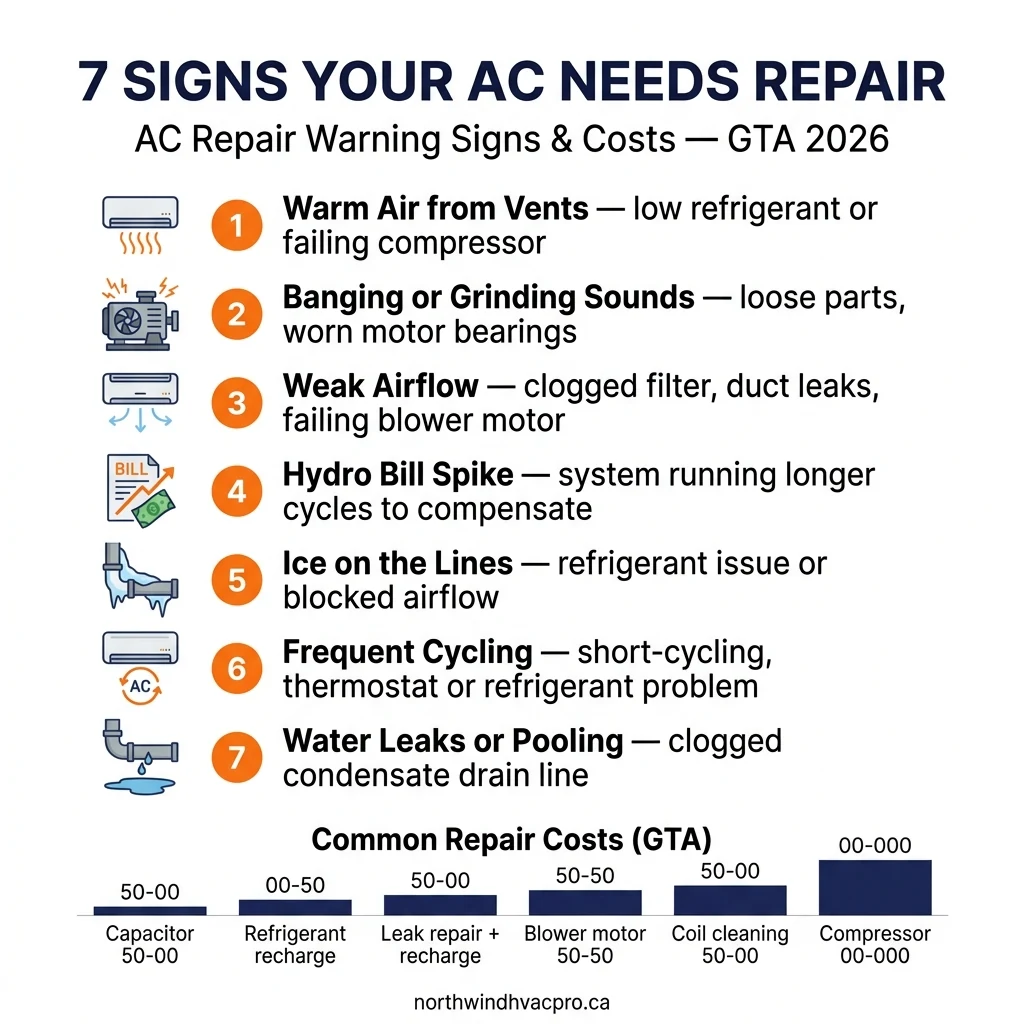
7 signs your AC needs repair
1. Warm or barely cool air coming from the vents
This is the most obvious one: you set the thermostat to 21, the system runs, but the air coming out feels warm or just barely cooler than the room. Before you call anyone, check that the thermostat is set to “cool” (not “fan only”) and that the temperature is set below your current indoor reading. If all that looks fine, the problem is likely inside the system.
The two most common causes are low refrigerant and a failing compressor. Low refrigerant usually means there’s a leak somewhere in the system. Refrigerant doesn’t just disappear on its own, so topping it off without finding the leak is only a temporary fix. A compressor issue is more serious and can run anywhere from $800 to $2,000 to address depending on the unit size and what specifically failed.
A dirty evaporator coil can also cause this. When the coil is covered in dust and grime, it can’t absorb heat properly and the system struggles to cool the air. Regular maintenance prevents this, but if it’s been a few years since your last service, a coil cleaning may be the fix you need.
2. Banging, grinding, or squealing sounds
A quiet hum when the AC kicks on is normal. Anything else, banging, grinding, squealing, rattling, is not. Each sound points to something specific. Banging usually means a loose or broken component inside the air handler or outdoor unit, sometimes a fan blade, sometimes a mounting bracket. Grinding typically means the motor bearings are worn down.
Squealing is often a belt issue on older units, or it can indicate a motor that’s starting to fail. Rattling at startup that goes away after a few seconds might just be a loose panel, but rattling that persists usually means something is loose inside the unit and getting worse with every cycle.
Don’t ignore these sounds hoping they’ll go away. A minor issue like a loose fan blade is a straightforward fix. Left alone, it can damage the coil, the housing, or the motor, and a $200 repair becomes a $1,200 one. If you hear something you don’t recognize, turn the system off and call for a diagnosis.
3. Weak airflow from the vents
If the air is cool but there’s barely any of it moving through your vents, the system is working harder than it needs to and still not keeping up. The first thing to check is your air filter. A clogged filter restricts airflow dramatically and is one of the most common causes of weak output. If the filter looks grey and matted, swap it out first and see if that makes a difference.
If the filter is clean and airflow is still low, the blower motor may be failing, or there could be a blockage or leak in the ductwork. Duct leaks are surprisingly common in older GTA homes, especially in houses where the ducts run through unconditioned attic space. You can lose 20 to 30 percent of your cooling before it even reaches the living area.
A failing blower motor will often show other signs too: unusual sounds when the fan runs, or the fan not reaching full speed. This is a repair that needs a technician. A new blower motor typically costs $350 to $650 installed, depending on the unit.
4. Your hydro bill spiked without explanation
An AC that’s struggling will run longer cycles to reach the set temperature, and that extra runtime shows up directly on your electricity bill. If you’re comparing this July’s bill to last July’s and it’s noticeably higher, and your usage habits haven’t changed, the AC is a logical suspect.
Efficiency drops happen for several reasons: dirty coils, low refrigerant, a failing capacitor, or just age. As the mechanical components wear, the system needs more energy to do the same job. A tune-up can sometimes recover a meaningful amount of that lost efficiency. If the system is older, you might also want to look at the bigger picture and compare the cost of repairs against what a newer high-efficiency unit would save you annually.
If you want a rough benchmark, a properly functioning central AC should hold fairly steady year over year in terms of hydro consumption for similar weather. A 15 to 25 percent jump in summer electricity use without a heat wave or lifestyle change usually means something mechanical has changed inside the system.
5. Water pooling around the unit or ice on the coils
A small amount of condensation around the indoor air handler is normal. Actual pooling water on the floor, or ice forming on the refrigerant lines or the outdoor unit, is not. Ice on the coils usually means the system is running without enough airflow (often a clogged filter) or is low on refrigerant. When the refrigerant pressure drops too low, the coil temperature drops below freezing and moisture in the air freezes onto it.
If you see ice, turn the AC off and let it thaw completely before running it again, usually a few hours. Check and replace the filter. If ice forms again after that, you have a refrigerant issue and need a technician. Running an iced-over unit doesn’t speed up the fix, it just puts more stress on the compressor.
Water pooling indoors is usually a blocked condensate drain line. This is a common problem, especially in humid GTA summers where the drain line sees a lot of moisture. A blocked line causes the drain pan to overflow. Left alone it can damage flooring, drywall, and in finished basements, a lot more. This is a straightforward repair but should be handled before it becomes a water damage claim.
6. Burning or musty smells when the AC runs
A burning smell when the AC first kicks on in the season can sometimes be dust burning off the heat exchanger. That usually clears in a few minutes. If it doesn’t, or if you smell burning during normal operation, that’s a different situation. It could be an overheating motor, a failing capacitor, or an electrical issue. Turn the system off and don’t run it until a technician has looked at it.
Musty smells are almost always mold or mildew. The evaporator coil and drain pan are damp environments, and if there’s standing water or poor airflow, mold grows. The air from the vents then carries that smell throughout the house. Beyond being unpleasant, you’re also pushing mold spores into the living space every time the system runs.
Coil cleaning and drain line flushing can address the source of the mold. For homes with ongoing air quality concerns, a UV air purification system can help prevent mold growth on the coil going forward. It’s not a fix for an existing problem, but it reduces how often the problem comes back.
7. The AC turns on and off every few minutes
A normal cooling cycle runs somewhere between 15 and 20 minutes. If your AC kicks on, runs for 2 or 3 minutes, shuts off, then kicks on again, it’s short-cycling. This is hard on the compressor because startups are the most stressful part of the cycle. Frequent short-cycling can shorten the life of a compressor by years.
Short-cycling has several possible causes. An oversized unit that cools the space too quickly will short-cycle by design, and that’s a sizing problem that can’t really be fixed without replacing the system. More commonly though, the cause is a failing capacitor, a refrigerant issue, a dirty filter, or the system overheating and tripping its safety switch.
Capacitor failure is one of the more common AC repairs in Ontario, especially as systems age past the 8 to 10 year mark. A capacitor replacement is usually $150 to $300 and is a quick fix if that’s all that’s wrong. Don’t let short-cycling go unaddressed. It will eventually take out the compressor, and compressor replacement is the most expensive repair on this list.
Did you know?
Capacitor failure is the single most common AC repair in the GTA, particularly on systems that are 8 years or older. A run capacitor helps start and sustain the compressor and fan motors. When it fails, the system may run but not cool, or the outdoor unit won’t kick on at all. The repair is usually under $300 and takes under an hour.
How to diagnose your AC before calling
Before you call a technician, there are a few things worth checking yourself. They take 5 minutes, and sometimes one of them solves the problem entirely.
Check the air filter first
Pull the filter out and hold it up to a light. If you can’t see light through it, it’s clogged. A clogged filter causes weak airflow, freezing coils, and higher energy bills. It’s also the cause of more AC service calls than most people realize. Filters should be replaced every 1 to 3 months depending on the type and how much the system runs. During peak summer operation, check it monthly.
Swapping a clogged filter for a clean one can sometimes restore normal operation immediately. If you replace the filter and things improve, you’ve found the problem. If the same issues come back within a week or two, there’s something else going on and a service call makes sense.
Check the thermostat settings
Make sure the thermostat is set to “cool” and not “fan.” Set the temperature at least 3 to 5 degrees below your current indoor reading to trigger a cooling call. If you have a smart thermostat, check whether it’s in a scheduled mode that might be holding back cooling. Sometimes what feels like an AC problem is a thermostat setting that someone changed.
If the thermostat display is blank or unresponsive, check the batteries. Smart thermostats can also lose their Wi-Fi connection and behave oddly. A quick reset sometimes clears it. If the thermostat itself is the problem, replacement is usually $200 to $500 installed for a programmable or smart model.
Look at the outdoor unit
Go outside and look at the condenser unit. Is the fan spinning when the system is running? Is the unit making unusual sounds? Check whether weeds, overgrown grass, or debris have blocked the sides. The condenser needs clear airflow all around it to work properly. At least 2 feet of clear space on all sides is the standard recommendation.
Also check that the circuit breaker for the AC hasn’t tripped. If the unit isn’t running at all and everything else looks normal, a tripped breaker is worth checking before assuming the system has failed. Reset it once. If it trips again immediately, there’s an electrical fault and a technician needs to find it before you try to run the system.
What AC repairs actually cost in the GTA (2026)
These are realistic price ranges for common AC repairs in the Toronto and GTA market. Labour rates in the GTA tend to be higher than in smaller Ontario cities, so if you’ve seen lower numbers quoted online from American sources, they won’t apply here.
| Repair type | Estimated cost (GTA, 2026) |
|---|---|
| Capacitor replacement | $150 to $300 |
| Refrigerant recharge (R-410A) | $200 to $450 |
| Refrigerant leak repair + recharge | $350 to $700 |
| Blower motor replacement | $350 to $650 |
| Evaporator coil cleaning | $150 to $300 |
| Condensate drain line clearing | $100 to $200 |
| Compressor replacement | $800 to $2,000 |
Most HVAC companies in the GTA charge a diagnostic fee of $80 to $150 to come out and assess the problem. That fee is typically applied toward the repair cost if you proceed with the work. Ask about this upfront. Some companies advertise no diagnostic fee but build it into their labour rate, so the net cost is similar either way. Get the total repair cost confirmed in writing before the technician starts.
Save your money
Most HVAC companies in the GTA charge an $80 to $150 diagnostic fee that gets applied to the repair if you proceed. Ask about this upfront before booking. Also ask whether they stock common parts on the truck. A company that can complete the repair in one visit costs you less than one that charges a second trip fee to return with the part.
Should I repair or replace my AC?
This tool is a rough guide only. A licensed HVAC technician can give you an accurate assessment based on your specific unit.
Repair or replace?
This is the question most homeowners eventually have to answer, and the answer depends on a few factors that don’t always point the same direction. Here are two practical frameworks that help.
I wasn’t informed about the capacitor or coil cleaning costs before the tech added them to the invoice, so I didn’t even have the option to shop around or do the maintenance myself.
r/hvacadvice homeowner, 2024
The 50% rule explained
The 50% rule is a rough guideline: if the repair costs more than 50% of what a new unit would cost, replacement is usually the better financial decision. A new central air conditioner in the GTA runs roughly $3,500 to $6,000 installed depending on the size and efficiency rating. So if a repair quote comes in at $2,000 or more, it’s worth getting a replacement quote at the same time before committing.
The rule is imperfect because it doesn’t account for age or condition. A $1,500 repair on a 3-year-old system is probably worth doing. The same repair on a 14-year-old system may not be, because the unit is near the end of its useful life and another repair will likely follow within a couple of years. You need to factor in both the repair cost and the remaining useful life together. For more detail on new AC pricing, see our breakdown of central air conditioner costs in Ontario.
Age matters more than cost
If your AC is 12 years old or older and you’re facing a major repair, the honest answer is that it probably makes more sense to replace it. Not because the repair won’t work, but because the system has already lived most of its expected life and the next repair is usually not far behind. A new high-efficiency unit will also use noticeably less electricity, so the savings on your hydro bill offset some of the replacement cost over time.
If you’re looking at replacement, a heat pump is worth considering. Heat pumps provide both heating and cooling and are currently eligible for significant government rebates in Ontario. The Canada Greener Homes Grant and the Ontario programs have changed over the past few years, so check our updated post on heat pump grants in Ontario for the current amounts and eligibility rules.
| Factor | Lean toward repair | Lean toward replace |
|---|---|---|
| System age | Under 10 years | 12 years or older |
| Repair cost vs new unit | Under 25% of replacement cost | Over 50% of replacement cost |
| Repair history | First major repair | Second major repair in two years |
| System efficiency | Still running efficiently | High energy bills, R-22 refrigerant |
| Failure type | Capacitor, motor, drain line | Compressor failure, refrigerant leak on old system |
| Rebate eligibility | Not a factor | New heat pump may qualify for Ontario rebates |
How long does an AC last in Ontario?
A central air conditioner in Ontario typically lasts 12 to 15 years with reasonable maintenance. Some run well past 15, but efficiency drops noticeably after 10 to 12 years even when nothing has technically broken. The GTA climate is hard on outdoor equipment: hot, humid summers, cold winters, freeze-thaw cycles, and road salt carried on the wind all take their toll on the condenser unit over time.
Annual maintenance, which means a spring tune-up before the cooling season, extends lifespan noticeably. Technicians catch small problems before they become big ones, clean the coils, check the refrigerant level, and test the electrical components. The cost of a tune-up, usually $100 to $150, is almost always worth it compared to an emergency repair in mid-July. Units that go years without any service tend to fail earlier and more expensively.
Pro tip
Schedule your AC tune-up in April or early May, before the cooling season starts. You’ll get better availability, often a lower rate, and you won’t be scrambling for an appointment during a July heat wave when every HVAC company in the GTA is fully booked. A spring tune-up typically costs $100 to $150 and is the single best way to avoid a summer breakdown.
If your unit is between 10 and 12 years old and still running well, start budgeting for replacement in the next 2 to 4 years. That way you can replace it on your schedule, during a shoulder season when installers are less busy, rather than in the middle of a heat wave when you have no leverage.
Service areas for AC repair
NorthWind provides AC repair across the Greater Toronto Area, including:
- Vaughan
- Mississauga
- Brampton
- Markham
- Richmond Hill
- Scarborough
- Etobicoke
- Aurora and Newmarket
- Oakville and Burlington
- Ajax, Pickering, and Whitby
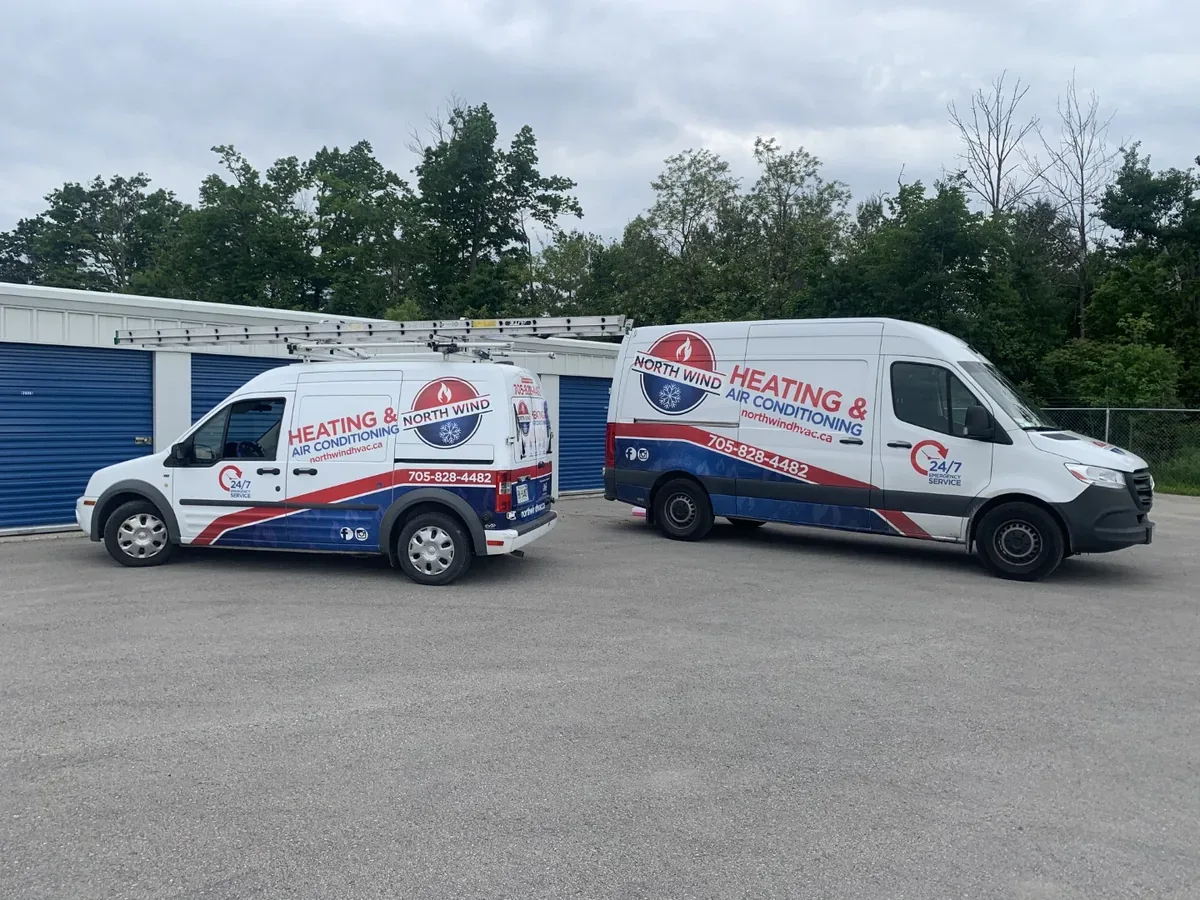
Book AC repair in the GTA
NorthWind Heating and Cooling handles AC repairs across the GTA, from quick capacitor swaps to full refrigerant leak diagnoses. Same-day and next-day appointments are available throughout the cooling season. All repair work comes with a parts and labour warranty, and the diagnostic fee is applied toward the repair if you proceed.
If you’re not sure whether to repair or replace, a technician can give you an honest read on the unit’s condition and what it’s likely to need over the next couple of years. Request a free estimate online or call us directly to book. We cover the full GTA and surrounding areas and aren’t going to push you toward a replacement if a repair makes more sense for your situation.
Frequently asked questions
How much does AC repair cost in Toronto?
Most AC repairs in the GTA fall between $150 and $700 depending on what’s wrong. Minor repairs like capacitor replacement or drain line clearing are on the lower end. Refrigerant leak repairs and motor replacements are in the middle range. Compressor replacement is the most expensive common repair, usually $800 to $2,000. Diagnostic fees are typically $80 to $150 and are often applied to the repair cost.
Can I recharge my own AC refrigerant?
No. Handling refrigerants requires an EPA 608 certification in the US and equivalent credentials in Canada under the federal regulations governing ozone-depleting substances and fluorinated gases. Purchasing refrigerant without a license isn’t possible through legitimate suppliers. Beyond the legal side, adding refrigerant without finding and fixing the leak first just delays the problem. A technician needs to locate the leak, repair it, and then recharge the system properly.
What is the most common AC problem in the GTA?
Capacitor failure is probably the single most common repair we see, especially on systems that are 8 years or older. Capacitors help start and run the compressor and fan motors, and they degrade over time. A failed run capacitor will prevent the compressor or fan from starting, which shows up as a unit that runs but doesn’t cool, or an outdoor unit that doesn’t kick on at all. It’s a quick fix when caught early.
How long does it take to repair an AC?
Most common repairs take 1 to 3 hours on-site. A capacitor replacement is usually under an hour. A refrigerant recharge takes longer because the technician needs to check for leaks first, which adds time. If a part needs to be ordered, there may be a return visit, but most common components are stocked on service vehicles or available same-day from local suppliers. Compressor replacement, if it comes to that, usually takes half a day.

Written by
Michael Torres
Certified AC Technician | HRAI Member
Michael Torres has been servicing central air conditioning and ductless systems in the GTA for over a decade. He is a member of the Heating, Refrigeration and Air Conditioning Institute of Canada (HRAI) and holds refrigerant handling certification under the Environmental Protection Act.
